Chart Structure
Why Do BaZi Calculators Give Different Results?
BaZi calculators can give different results for four main reasons: how they handle birth time, whether they use true solar time, when they start a new day, and how they calculate solar-term boundaries.
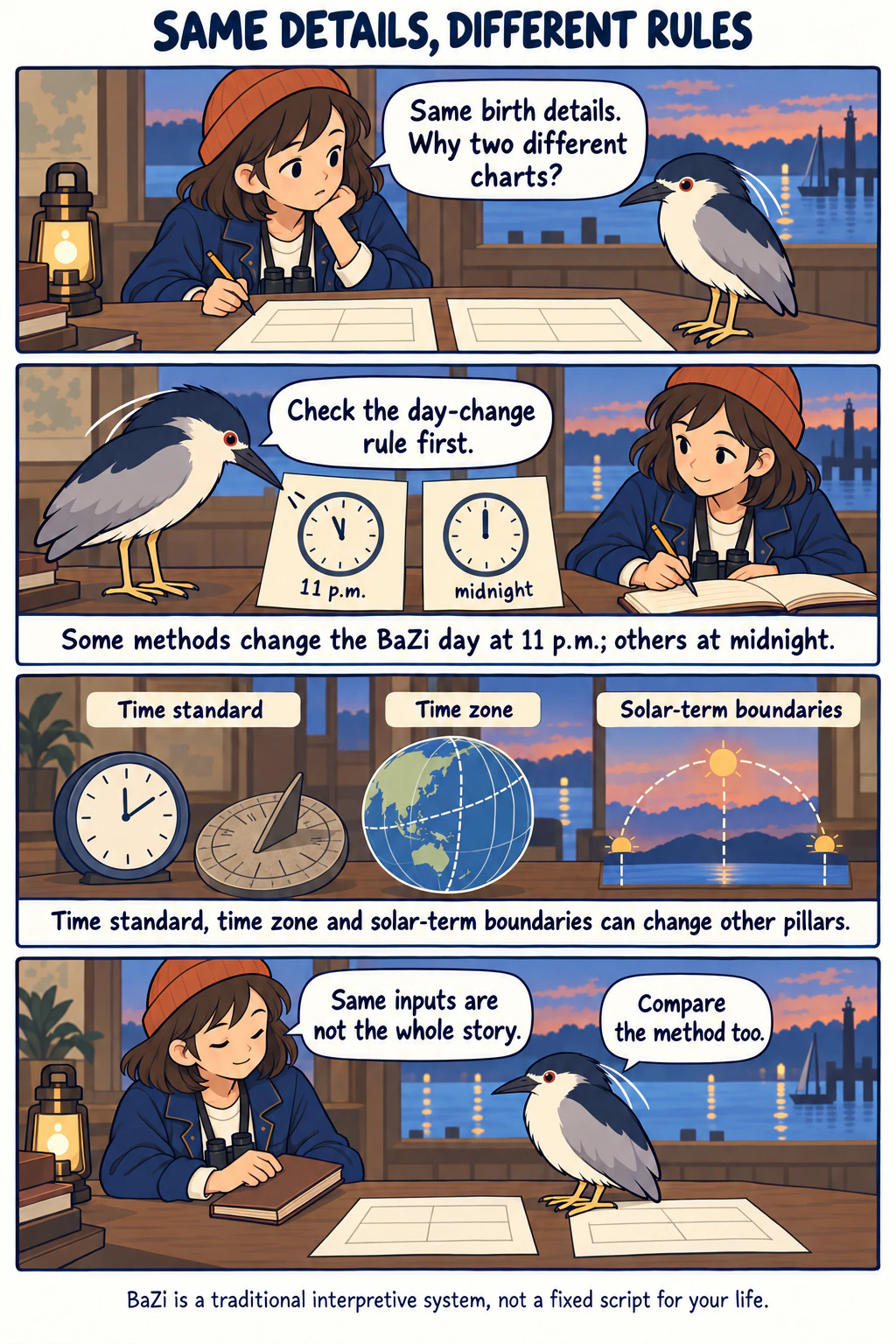
BaZi calculators can give different results for four main reasons: how they handle birth time, whether they use true solar time, when they start a new day, and how they calculate solar-term boundaries.
Same inputs are not the whole story. Compare the method too.
Read the comic as text
- Reader question. Apprentice: “Same birth details. Why two different charts?”
- Day boundary. Heron: “Check the day-change rule first.” Caption: “Some methods change the BaZi day at 11 p.m.; others at midnight.”
- Other conventions. Caption: “Time standard, time zone and solar-term boundaries can change other pillars.”
- Takeaway. Apprentice: “Same inputs are not the whole story.” Heron: “Compare the method too.”
BaZi is a traditional interpretive system, not a fixed script for your life.
The full guide

You enter the same birth date, time, and location into two BaZi calculators, but they show different charts. One says your Day Master is Jia Wood. The other says Yi Wood. Which one is right?
BaZi calculators can give different results for four main reasons: how they handle birth time, whether they use true solar time, when they start a new day, and how they calculate solar-term boundaries.
The most common differences come down to time. Some calculators use the local clock time recorded at birth, while others adjust it to true solar time. Some begin a new BaZi day at 11 p.m., while others wait until midnight. These choices can change one or more characters in your chart.
To see how this happens, let’s follow a simple example.
1. How Can the Same Birthday Produce Two Different Charts?
Imagine Emma was born on June 15 at 11:30 p.m.
She has recently started learning BaZi and enters her birth details into two different websites.
The first calculator identifies her Day Master as Jia Wood. The second gives her a different Day Master.
Emma checks her birthday, birth time, and birthplace. Everything matches.
So what happened?
The answer may be hiding in a setting she has never noticed: when does a new day begin in BaZi?
BaZi (八字, bā zì), also known as the Four Pillars (四柱, sì zhù), uses eight Chinese calendar characters arranged in four pairs:
- Year Pillar
- Month Pillar
- Day Pillar
- Hour Pillar
Each pillar contains a Heavenly Stem and an Earthly Branch. The Heavenly Stem of the Day Pillar is called the Day Master (日主, rì zhǔ), an important reference point in traditional BaZi interpretation.
If two calculators assign Emma’s birth to different BaZi days, her Day Pillar—and therefore her Day Master—will be different.
That gives Emma her first clue.
2. Does a New BaZi Day Begin at 11 p.m. or Midnight?
In everyday life, we think of a new day as beginning at midnight.
But traditional BaZi calculations do not always follow that rule.
The Zi Hour (子时, zǐ shí) runs from approximately 11 p.m. to 1 a.m. Different calculation conventions treat the first part of this period differently.
One method begins the new BaZi day at 11 p.m.
Another keeps the current day until midnight.
Remember Emma’s birthday: June 15 at 11:30 p.m.
| Day-change rule | Date assigned to Emma’s Day Pillar |
|---|---|
| New day begins at 23:00 | June 16 |
| New day begins at 00:00 | June 15 |
The birth record has not changed. Only the rule used to assign the BaZi day has changed.
And because the Day Master comes from the Day Pillar, the result changes with it.
Emma now understands why her two charts show different Day Masters: the calculators are using different day-change conventions.
The marginalpoems calculator uses the 23:00 day-change rule. In our system, a new BaZi day begins at 11 p.m.
If you were born between 11 p.m. and midnight, this is the first setting worth checking when two calculators disagree.
3. Why Can Your Birthplace Change the Result?
Emma has solved her first question, but she notices another setting on some BaZi websites: True Solar Time.
What does that mean?
The time shown on your clock is civil time. People within the same legal time zone generally follow the same clock.
But the Sun does not reach the same position in the sky at exactly the same clock time everywhere within that zone.
For example, two cities in the same time zone may both show 11 a.m., even though the Sun is at different positions in their skies.
True solar time, or local apparent solar time, measures time according to the Sun’s apparent position at a particular location.
Some BaZi calculators adjust birth time using this method before determining the Hour Pillar. Others use the recorded local civil time.
Consider Emma’s friend, whose birth certificate records 10:50 a.m.
Using civil time, the birth falls within the traditional Si Hour, from 9 a.m. to 11 a.m.
Now imagine another calculator applies a solar-time adjustment, moving the working time to 11:10 a.m.
That places the birth in the following period, the Wu Hour.
The Hour Pillar can therefore change even though the recorded birth time stays the same.
This is a simplified example using an assumed time adjustment, rather than a calculation for a particular birthplace.
marginalpoems V1 uses the local civil time recorded at birth. It does not apply true-solar-time correction.
If two charts have different Hour Pillars, check whether one calculator has true solar time enabled.
Time zones and daylight saving time can also affect the result. The easiest starting point is to enter the original time from your birth record and check how each calculator handles local time, rather than adjusting the hours yourself.
4. Why Can the Year and Month Pillars Be Different?
Suppose Emma’s birthday is nowhere near 11 p.m., but two calculators still show different Year or Month Pillars.
The next thing to check is the solar terms.
Many beginners assume BaZi years change at Chinese Lunar New Year and months change on the first day of each lunar month.
In common Four Pillars calculation methods, however, Year and Month Pillars follow solar-term boundaries.
Solar terms (节气, jié qì) are 24 traditional seasonal markers based on the Sun’s apparent movement throughout the year.
The Year Pillar: Why Li Chun Matters
Many BaZi methods begin a new Year Pillar at Li Chun (立春, lì chūn), the Start of Spring.
Li Chun usually falls in early February. Its date is not necessarily the same as Chinese Lunar New Year.
Someone born between these two dates may therefore receive different Year Pillars from calculators that use different year boundaries.
The Month Pillar: Why It Does Not Change on the First
BaZi months also follow seasonal boundaries.
That means a new Month Pillar does not necessarily begin on the first day of a Gregorian or lunar month.
If someone is born close to a solar-term transition, the exact transition time matters.
Two calculators using different transition times—or converting those times incorrectly—may assign the birth to different BaZi months.
You do not need to memorize all 24 solar terms to understand this.
Just remember: BaZi years and months have their own calendar boundaries, and those boundaries do not always match the dates on an ordinary calendar.
For births near the beginning of a BaZi year or month, those boundaries are especially important.
5. What Should You Do When Two BaZi Charts Disagree?
Now that you know the main reasons, you can compare your charts in a much simpler way.
Start as Emma did: place the two charts side by side and find out exactly what is different.
| What differs? | What to check first |
|---|---|
| Day Pillar | Does the calculator change days at 23:00 or 00:00? |
| Hour Pillar | Does it use true solar time? Is the birth time correct? |
| Year Pillar | Does it use Li Chun as the year boundary? |
| Month Pillar | Does it use the same solar-term transition? |
| Same Four Pillars, different readings | Are the interpretation methods different? |
This table gives you a practical place to begin.
If you cannot find a calculator’s rules, look for a Methodology page or an explanation of its calculation settings.
Without that information, it can be difficult to understand why two results differ.
That is why a good BaZi calculator should do more than display eight characters. It should help readers understand how those characters were calculated.
So Which Calculator Is More Accurate?
It depends on what you are comparing.
If two calculators use the same rules but produce different charts, the calculations deserve a closer look.
If they follow different traditional conventions, the first step is to understand those differences rather than immediately declaring one result wrong.
There is also a distinction between calculating a chart and interpreting it.
Even when two websites produce exactly the same Four Pillars, they may explain the chart differently.
BaZi is a traditional interpretive system, not a scientifically validated method for predicting a person’s future. Its calculations can be checked against stated rules, but its interpretations should not be treated as certain predictions.
For beginners, the best starting point is not finding the reading that sounds most like you. It is understanding how your chart was calculated in the first place.
To learn more about the calculation process, read How to Calculate a BaZi Chart.
If you already have a chart but are unsure what its characters mean, continue with How to Read a BaZi Chart.
You can also visit the marginalpoems Methodology page to understand the rules used by our calculator.
FAQ
Why do two BaZi calculators show different Day Masters?
The first thing to check is the day-change rule. For births between 11 p.m. and midnight, some calculators assign the birth to the following BaZi day, while others keep the current day. Since the Day Master comes from the Day Pillar, this difference changes the result.
Do I have to use true solar time for BaZi?
Different BaZi calculation methods use different time standards. Some calculators adjust birth time to true solar time, while others use the local civil time recorded at birth. When comparing results, check which standard each calculator uses.
What should I check if I was born near midnight?
Start by confirming your recorded birth time and checking the calculator’s day-change rule. If historical daylight saving time or time-zone changes apply to your birthplace, check how the tool handles those as well.
How can I tell whether a BaZi calculator is reliable?
Look for a calculator that clearly explains its rules. Pay particular attention to how it handles birth time, true solar time, day changes, and solar-term boundaries. Understanding those rules makes it easier to evaluate the chart you receive.
Read about our calculation conventions, sources and review process in our methodology.
Keep the whole chart in view