Chart Reading
How to Read a BaZi Chart: A Beginner's Order
Find the Day Master, then check the birth season. Look at how the chart's characters relate to one another.
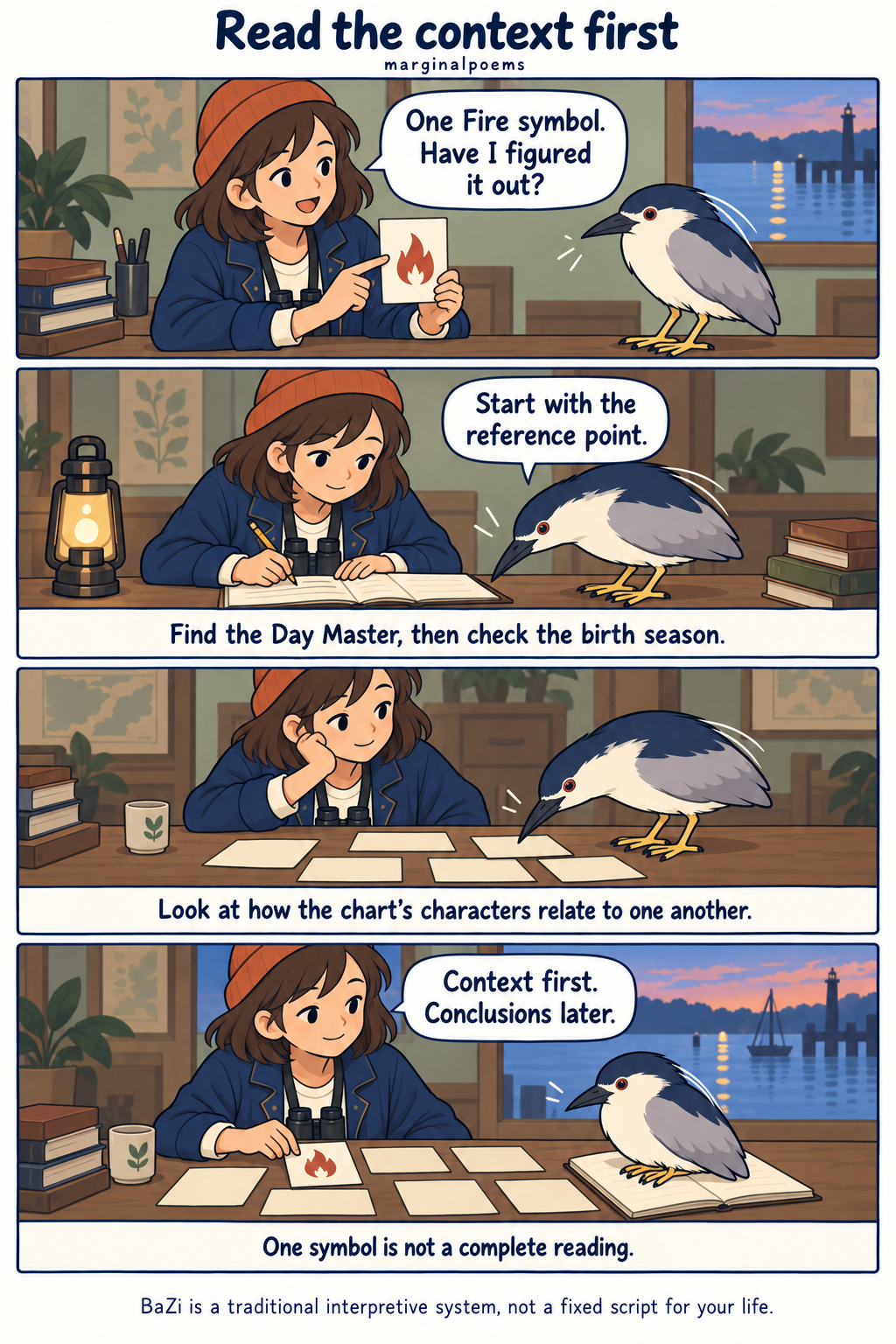
Find the Day Master, then check the birth season. Look at how the chart's characters relate to one another.
One symbol is not a complete reading.
Read the comic as text
Apprentice: "One Fire symbol. Have I figured it out?"
Heron: "Start with the reference point." Caption: "Find the Day Master, then check the birth season."
Caption: "Look at how the chart's characters relate to one another."
Apprentice: "Context first. Conclusions later." Caption: "One symbol is not a complete reading."
BaZi is a traditional interpretive system, not a fixed script for your life.
The full guide

To read a BaZi chart, begin with the Day Master and the birth season. Then examine how the other seven characters relate to that reference point, how the chart is structured, and how later timing cycles change its conditions. This order keeps one symbol from becoming a personality label or a guaranteed prediction. It is a beginner framework, not a mechanical formula for every chart.
What Exactly Is a BaZi Chart?
A BaZi chart (八字, bā zì) is built from four columns — one each for year, month, day, and hour of birth. These are the Four Pillars (四柱, sì zhù). Each pillar holds two characters: a Heavenly Stem (天干, tiān gān) on top and an Earthly Branch (地支, dì zhī) below. That gives you eight characters total, which is what “BaZi” literally means: “eight characters.”
The Day Master (日主, rì zhǔ) is the Heavenly Stem in the Day Pillar. It is the chart’s reference point for the person being read. Think of the chart as a plot of land: the Day Master is the plant you are studying, while the season and surrounding characters describe its conditions.
BaZi has a method, and that method starts with careful observation of the given structure—not guessing or dramatic declarations. If you want the fuller foundation before continuing, our What Is BaZi? A Complete Beginner’s Guide covers the history and core assumptions in more depth.
Why Do You Find the Day Master First?
The Day Master is the analytical anchor for the chart. For each of the other characters, ask whether its element supports the Day Master, draws from it, controls it, or is controlled by it. Branch combinations and clashes are examined separately. Without a reference point, the eight symbols do not yet form a readable set of relationships.
To make those relationships meaningful, you need the grammar of the system: the Five Elements (五行, wǔ xíng) — Wood, Fire, Earth, Metal, Water. They operate in two cycles. The generating cycle: Wood feeds Fire, Fire creates Earth, Earth bears Metal, Metal produces Water, Water nourishes Wood. The controlling cycle: Wood parts Earth, Earth dams Water, Water quenches Fire, Fire melts Metal, Metal chops Wood.
Simplified teaching example: Mei is a fictional person born in a summer month with a Fire Day Master. Her summer month and additional Fire support the Day Master. Earth may draw energy from Fire, so it must be weighed separately rather than counted as support.
This does not finish the judgment. A reader would also check the branches, the elements concealed within them, and any combinations that change how the visible characters behave. The example shows the reading order, not a complete verdict about Mei.
How Do You Judge Whether the Day Master Is Strong or Weak?
Strength assessment is not a simple count of how many times each element appears. You begin with the season, then examine whether the Day Master has roots in the branches, what supports or drains it, and whether combinations change how those forces behave. A visible element can be weak, while a less visible one may be strongly rooted.
The month branch is usually the first major reference point. The tradition calls its seasonal influence the Month Command (月令, yuè lìng). A Water Day Master born in winter receives strong seasonal support, but that fact alone does not settle the whole chart. In Mei’s case, a summer month gives her Fire Day Master an important advantage before you examine roots and the other pillars.
What Does “Useful God” Mean in Plain English?
The “Useful God” (用神, yòng shén) is not a deity or religious figure. It is a technical label for an operative element or function that, depending on the school, may regulate seasonal climate, support the chart’s structure, or address an imbalance. The familiar English label is easy to misread, so the method behind the choice matters more than the literal wording.
Selecting the Useful God does not follow one automatic strong-versus-weak formula. Supporting a weak Day Master and restraining a strong one is one important method, but practitioners may also consider seasonal temperature, chart structure, and whether an apparent combination truly transforms. The Di Tian Sui puts the wider principle this way:
道有体用,不可以一端论也,要在扶之抑之得其宜。
Dào yǒu tǐ yòng, bù kě yǐ yī duān lùn yě, yào zài fú zhī yì zhī dé qí yí.
The Way has both substance and function; it cannot be judged from one side alone — the essence lies in supporting or restraining, each in its proper measure.
In plain English, the verse warns against judging a chart from one side. The task is to decide when support or restraint is appropriate. In Mei’s simplified example, Water might be investigated because it controls Fire, but only the full chart could show whether that function is actually helpful.
How Do the Ten Gods Connect Element Relationships with Life Themes?
The Ten Gods (十神, shí shén) are ten relationship categories between each character and the Day Master. Despite the English name, they are not deities. Practitioners use the categories to discuss possible life themes without turning one character into a promised event.
For a beginner walkthrough, two of them matter most. Wealth (财, cái) is the element that the Day Master controls—it can describe money, resources, and practical responsibility. Officer (官, guān) is the element that controls the Day Master—it can describe rules, authority, discipline, and career structure. If Water proves useful in Mei’s complete chart, it also maps to the Officer category because Water controls Fire. When Water appears, those themes may become more noticeable; it does not promise one particular event.
A necessary caveat: these are tendencies read from the full chart, not fixed predictions from a single element. A chart with one Water character does not guarantee a corporate career. The complete picture — all eight characters, their interactions, and the luck cycles — determines how any single label actually expresses itself.
How Do Luck Pillars Add Timing?
The natal chart is the garden’s original layout, but life still moves through changing seasons. Luck Pillars (大运, dà yùn) are roughly ten-year periods used to describe changes in the surrounding conditions.
Each Luck Pillar adds a stem and branch that practitioners compare with the natal chart. If the full chart confirmed Water as helpful and a later Water pillar entered, the next question would be how it interacts with the original characters. Its arrival would not guarantee a career, relationship, or other result. Di Tian Sui describes the system’s changing quality this way:
理承气行岂有常,进兮退兮宜抑扬。
Lǐ chéng qì xíng qǐ yǒu cháng, jìn xī tuì xī yí yì yáng.
Principle rides upon qi in motion — how could it ever stand still? In advance and in retreat, one must weigh restraint and release.
The text acknowledges that a chart is not a fixed verdict. The same person faces different conditions in different decades. A strong Fire Day Master in a Water decade is still the same person, just as the same plant remains itself when the season changes.
This is a beginner reading order, not a complete formula. It helps you avoid reading one symbol in isolation. Advanced work also compares structure, combinations, transformations, and differences among interpretive methods. A responsible reader should be able to explain both the reasoning and its limits.
FAQ
Q: How long does it take to learn to read a BaZi chart? A: There is no fixed timetable. You can learn to identify pillars, elements, and the Day Master relatively quickly. Reliable interpretation takes longer because season, roots, combinations, chart structure, and luck cycles interact. Start with the mechanics, compare worked examples, and delay confident predictions until you can explain why competing interpretations differ.
Q: Can I read my own BaZi chart, or do I need a professional? A: You can use your own chart for study once you understand the basic method. The main risk is confirmation bias: you may favor interpretations that match what you hope or fear. Keep a record of competing readings, distinguish calculation from interpretation, and avoid making medical, legal, or financial decisions from the chart alone. A teacher may help explain why methods differ.
Q: Is “Useful God” a religious term? A: No. In BaZi, Useful God (用神, yòng shén) is a technical term, not a deity. Depending on the interpretive school, it may mean an element or function used to regulate seasonal climate, support the chart’s structure, or address an imbalance. The English label can mislead beginners, so ask how the practitioner selected it instead of treating it as a religious claim.
Q: Do I need to know Chinese to read BaZi? A: You can learn the basic chart layout and relationship terms in English. Chinese becomes more useful when you study classical texts because one translated label may compress several meanings or hide disagreements among commentators. Compare translations, keep key Chinese terms beside the English, and note where a source is uncertain. Language access helps, but it does not remove the need for careful reasoning.
Q: How accurate are BaZi readings? A: BaZi has no scientifically established accuracy percentage. Within the tradition, a reading interprets patterns and timing conditions rather than guaranteeing events. Different schools may also reach different conclusions from the same chart. Treat the result as a framework for reflection, not a prediction engine, and do not use it in place of medical, legal, financial, or psychological advice.
Read about our sources, translations and review process in our methodology.
Keep the whole chart in view