BaZi Basics
How to Find Your BaZi Day Master
The Day Master is the Heavenly Stem in your Day Pillar.
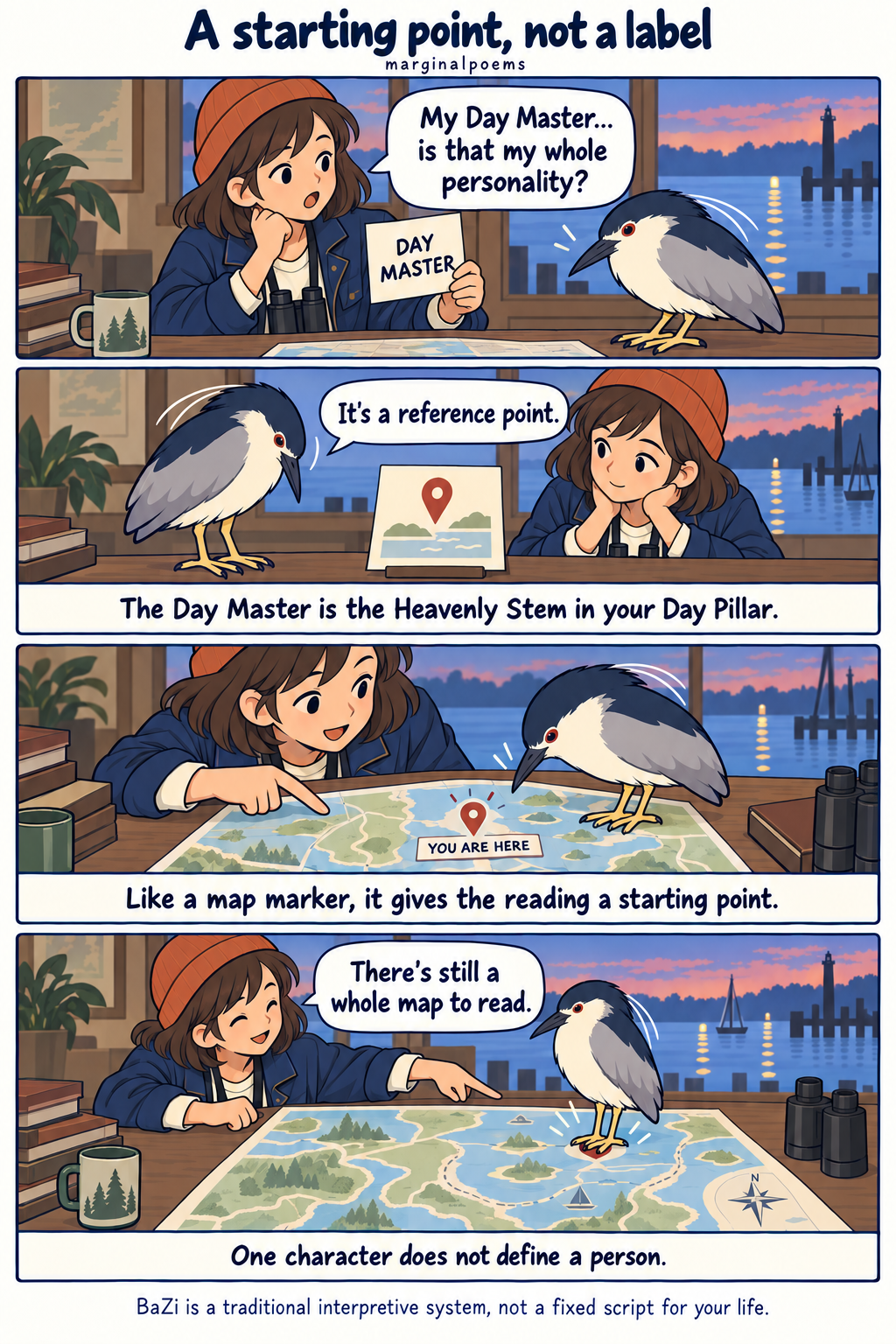
The Day Master is the Heavenly Stem in your Day Pillar.
Like a map marker, it gives the reading a starting point. One character does not define a person.
Read the comic as text
Apprentice: "My Day Master… is that my whole personality?"
Heron: "It's a reference point." Caption: "The Day Master is the Heavenly Stem in your Day Pillar."
Map label: "YOU ARE HERE" Caption: "Like a map marker, it gives the reading a starting point."
Apprentice: "There's still a whole map to read." Caption: "One character does not define a person."
BaZi is a traditional interpretive system, not a fixed script for your life.
The full guide

Your BaZi Day Master (日主, rì zhǔ) is the Heavenly Stem at the top of the Day Pillar. It represents the person whose chart is being read and serves as the reference point for all seven other characters. To find it reliably, look for the column labeled “Day”—not the third column from the left, because different calculators arrange the four pillars in different directions.
Where Is the Day Master on a BaZi Chart?
A BaZi chart has four labeled pillars: Year, Month, Day, and Hour. Each pillar contains a Heavenly Stem on top and an Earthly Branch below.
Four pillars. Two characters in each.
Each pillar has a Heavenly Stem above an Earthly Branch. Four pairs make eight characters.
Year 年柱
Month 月柱
Day 日柱
Hour 时柱
Some modern charts display the pillars as Year–Month–Day–Hour from left to right. Traditional layouts often reverse that order. The safe method is always the same:
- Find the pillar labeled Day.
- Look at its upper character, the Heavenly Stem.
- That character is the Day Master.
Here is a layout-only example:
| Pillar | Year | Month | Day | Hour |
|---|---|---|---|---|
| Heavenly Stem | — | — | Jia 甲 | — |
| Earthly Branch | — | — | Chen 辰 | — |
In this example, the Day Master is Jia Wood (甲木, jiǎ mù). Chen is the Day Branch, not the Day Master.
If the chart runs in the opposite direction, the Day column may appear second from the left. The label matters; the position does not.
For the wider chart structure, begin with What Is BaZi? A Beginner’s Guide.
Why Is the Day Master the Chart’s “You Are Here” Marker?
Think of a BaZi chart as a map. A map can show roads, rivers, slopes, and weather, but it needs a “You Are Here” marker before any direction becomes meaningful. The Day Master plays that role.
The other seven characters are not read as isolated personality labels. Their meaning depends partly on how they relate to the Day Master. An element may reinforce it, be produced by it, restrain it, or be restrained by it. Yin or Yang polarity adds another distinction.
Those relationships form the Ten Gods (十神, shí shén). Despite the English name, they are not gods. They group the other characters into five relationship families—peers, expression, wealth, authority, and support—then divide each family by Yin or Yang polarity.
For a Jia Wood Day Master, Water belongs to the Resource family because, in the Five Element cycle, Water supports Wood. Yang Ren Water and Yin Gui Water receive different Resource labels because their polarities differ.
The same element may receive a different relationship label when the Day Master changes. That is why you must identify the Day Master before assigning Ten God labels.
What Are the Ten Possible Day Masters?
There are ten Heavenly Stems, so there are ten possible Day Masters. Each combines one of the Five Elements with Yin or Yang polarity.
- Jia, Yang Wood: often pictured as a tall tree growing upward.
- Yi, Yin Wood: often pictured as a vine, grass, or flexible plant.
- Bing, Yang Fire: often pictured as the sun or broad radiant heat.
- Ding, Yin Fire: often pictured as a lamp or focused flame.
- Wu, Yang Earth: often pictured as a mountain or solid ground.
- Ji, Yin Earth: often pictured as cultivated soil.
- Geng, Yang Metal: often pictured as raw metal, an axe, or a blade.
- Xin, Yin Metal: often pictured as refined metal or jewelry.
- Ren, Yang Water: often pictured as an ocean or large river.
- Gui, Yin Water: often pictured as rain, mist, or dew.
These are teaching images, not ten fixed personality types. A Jia Day Master is not automatically principled, tall, stubborn, or successful. The image describes a style of elemental movement that must be read inside the full chart.
The classical text Di Tian Sui (滴天髓) begins its description of Jia Wood this way:
甲木参天,脱胎要火。
Jiǎ mù cān tiān, tuō tāi yào huǒ.
“Jia Wood towers toward the sky; to grow beyond its raw form it needs Fire.”
In plain English, even the image of a great tree immediately introduces context. Jia Wood has a natural direction, but what helps it depends on season and surrounding elements.
Can You Find Your Day Master from Your Birthday Alone?
For most dates, yes—but not by reading the Gregorian date alone. The Day Master comes from the Day Pillar in the continuous 60-pair stem-and-branch cycle, so you need a reference calendar or calculator.
Enter the birth date, birth time, and birthplace into a BaZi calculator. Then check that the tool states which solar-term and time conventions it uses. Once the four pillars appear, locate the Day label and take the top character.
If the birth time is unknown, you can still calculate the Day Master. The missing birth time affects the Hour Pillar, not the identity of the Day Stem. Births close to midnight require more care: some schools begin the BaZi day at 11:00 p.m., the start of the two-hour Rat period, while others use midnight.
What Can the Day Master Tell You?
The Day Master gives you the chart’s point of view. Its element and polarity help organize how the other characters are classified and how seasonal support is discussed.
In a simplified teaching example, Lina has a Jia Wood Day Master. If her Month Branch places her in spring, Wood receives seasonal support. That is an important clue, but it does not prove that the full chart is strong. The reader must still examine how the other characters reinforce, use, or restrain that Wood.
If Xin Metal appears elsewhere in Lina’s chart, it is classified as Direct Officer because Xin controls Jia with opposite polarity. That category may bring themes of rules, responsibility, authority, or structure into the analysis. It does not prove that Lina will work in government, obey every rule, or marry a particular kind of person.
Traits and life themes in BaZi are tendencies interpreted from the complete chart, not fixed predictions produced by one Day Master.
Is a Strong Day Master Better Than a Weak One?
No. Strong and weak describe capacity and context, not personal worth.
A reader begins with the Month Branch because it establishes the season. Then the reader checks whether the Day Master is reinforced by supportive elements, anchored in the branches through matching hidden stems, weakened by what it produces, or restrained by another element. Some character combinations may also change how the visible elements behave.
This is not a counting contest. Several visible but weak appearances may matter less than one element with strong seasonal support and a firm root in a branch.
Di Tian Sui emphasizes the importance of this judgment:
能知衰旺之真机,其于三命之奥,思过半矣。
Néng zhī shuāi wàng zhī zhēn jī, qí yú sān mìng zhī ào, sī guò bàn yǐ.
“Grasp the true mechanism of strength and weakness, and you have already understood more than half of the mysteries of destiny.”
Here, “destiny” is the text’s historical vocabulary; it does not mean that one Day Master fixes a life outcome. In plain English, finding the Day Master is easy. Understanding its condition is the real work.
What Should You Do After Finding Your Day Master?
For a complete sequence, follow How to Read a BaZi Chart. Do not jump straight to a list of personality traits. Use this order instead:
- Confirm the Day Master and its Yin or Yang polarity.
- Identify the Month Branch and season.
- Check roots, support, drainage, and control.
- Map the other characters into Ten God relationships.
- Examine combinations, clashes, and the chart’s wider structure.
- Only then consider Luck Pillars and annual timing.
The Day Master is the beginning of a BaZi reading, not the finished answer. On the map, you have found “You Are Here.” You still need to understand the terrain.
FAQ
Q: Is the Day Master always in the third column?
A: No. Some calculators display Year–Month–Day–Hour from left to right, while others display Hour–Day–Month–Year. Find the pillar labeled Day and take its upper Heavenly Stem. Do not rely on column position alone. The written labels are more reliable than the visual order.
Q: Is my Day Master the same as my Chinese zodiac animal?
A: No. The zodiac animal is the Earthly Branch of the Year Pillar. The Day Master is the Heavenly Stem of the Day Pillar. The year animal is one part of the chart; the Day Master is the reference point used to classify the other characters.
Q: Can my Day Master change over time?
A: No. The natal Day Master is fixed by the Day Pillar at birth. Luck Pillars and annual pillars add changing conditions around it, but they do not replace the original Day Stem. They describe later timing around the same natal reference point.
Q: Can I find my Day Master without knowing my birth time?
A: Usually, yes. The birth time determines the Hour Pillar, while the Day Master comes from the Day Pillar. However, births near a day-change boundary need careful handling because time conventions may affect which Day Pillar is used. Check the calculator’s stated day-boundary rule if the birth was close to midnight.
Q: Does my Day Master describe my whole personality?
A: No. It supplies the chart’s reference point and one layer of symbolism. Season, strength, roots, Ten Gods, combinations, Luck Pillars, personal choices, and real-life circumstances all affect how that symbolism is interpreted. It should never be treated as a standalone identity label.
Read about our sources, translations and review process in our methodology.
Keep the whole chart in view