BaZi Basics
BaZi vs Feng Shui: What's the Difference?
BaZi starts with your birth date and time. Feng Shui examines places: their form, orientation, use and timing.
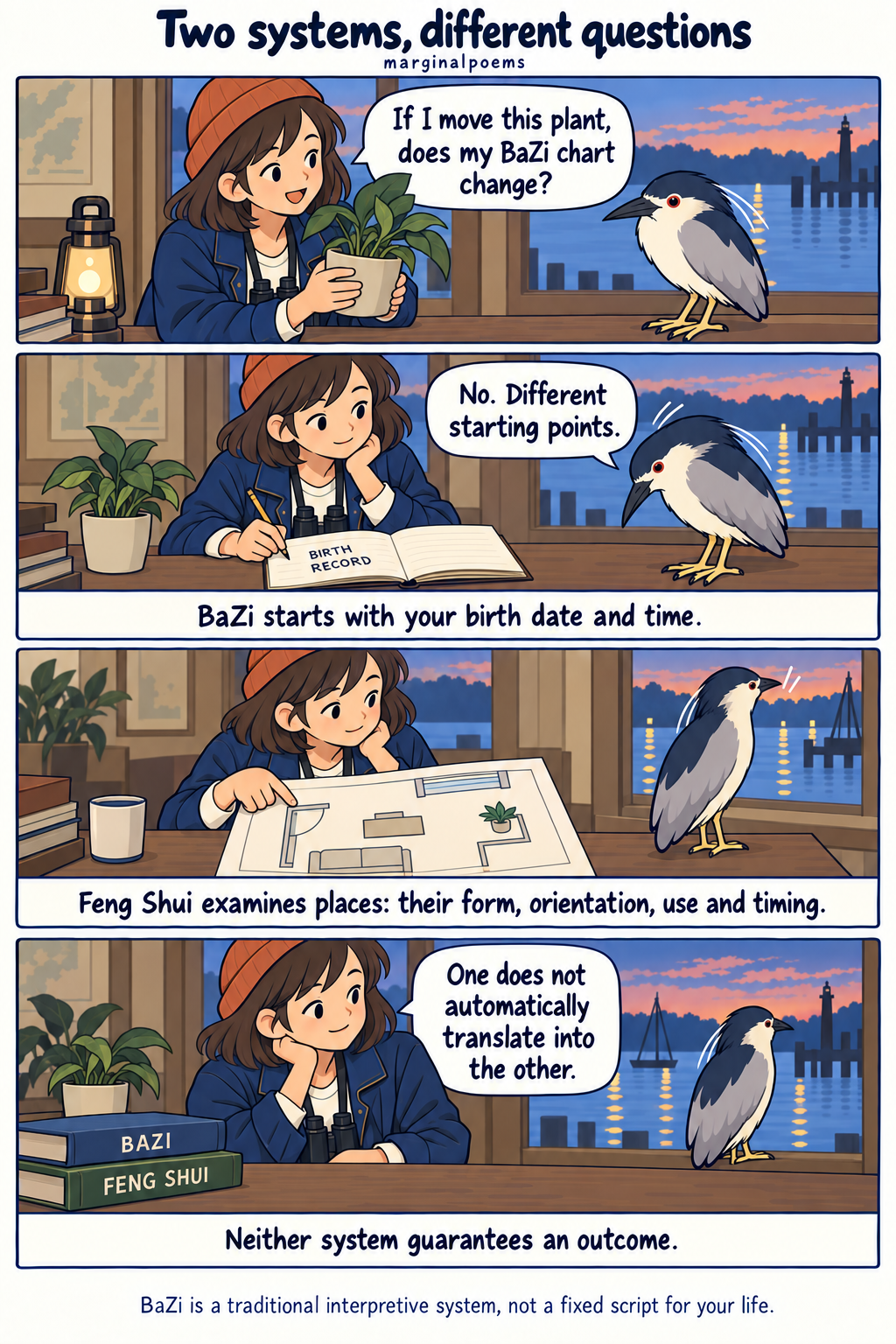
BaZi starts with your birth date and time. Feng Shui examines places: their form, orientation, use and timing.
One does not automatically translate into the other. Neither system guarantees an outcome.
Read the comic as text
Apprentice: "If I move this plant, does my BaZi chart change?"
Heron: "No. Different starting points." Caption: "BaZi starts with your birth date and time."
Caption: "Feng Shui examines places: their form, orientation, use and timing."
Apprentice: "One does not automatically translate into the other." Caption: "Neither system guarantees an outcome."
BaZi is a traditional interpretive system, not a fixed script for your life.
The full guide

BaZi and Feng Shui are separate traditional Chinese systems. BaZi uses a birth date and time to interpret personal patterns and changing periods; Feng Shui examines the form, orientation, timing, and use of places. Some practitioners combine them, but one cannot be reduced to the other, and neither guarantees an outcome. The clearest BaZi vs Feng Shui comparison is therefore time pattern versus place pattern—not fate versus a cure.
What Is the Key Difference Between BaZi and Feng Shui?
BaZi begins with a moment of birth. Its raw material is calendar information: year, month, day, and hour. Practitioners convert that information into a Four Pillars chart and interpret relationships among its symbols.
Feng Shui begins with a place. Depending on the school, practitioners may examine the surrounding land, building form, compass orientation, entrances, rooms, construction or occupancy timing, and how people use the site.
Think of them as two different charts for one voyage. BaZi is a traditional timing chart used to discuss the traveler and changing conditions. Feng Shui is a site survey of the harbor, routes, and built environment. They may inform the same decision, but they are drawn from different evidence.
People compare them because both may use terms such as qi, Yin and Yang, and the Five Elements. Shared vocabulary does not make them one method. Schools also differ over whether and how the two systems should be combined.
How Does BaZi Work?
BaZi (八字, bā zì) literally means “Eight Characters.” A birth year, month, day, and hour are each assigned a Heavenly Stem and an Earthly Branch. The resulting four pairs are called the Four Pillars (四柱, sì zhù).
The Heavenly Stem of the Day Pillar is the Day Master (日主, rì zhǔ). It serves as the chart’s reference point for the person being read. Practitioners then examine season, the Five Elements, the relationships among the other characters, and later timing cycles.
This does not make the chart an internal blueprint or a set of genetic instructions. It records birth-time conditions inside a traditional interpretive framework. A reader may use it to discuss tendencies or periods of pressure and support, but choices, relationships, health, opportunity, and social circumstances remain outside any single chart.
Di Tian Sui (滴天髓), a classical BaZi text, describes change this way:
理承气行岂有常,进兮退兮宜抑扬。
Lǐ chéng qì xíng qǐ yǒu cháng, jìn xī tuì xī yí yì yáng.
“Principle rides upon qi in motion — how could it ever stand still? In advance and in retreat, one must weigh restraint and release.”
Within BaZi, the verse supports a view of conditions as dynamic rather than fixed. It does not establish a claim about Feng Shui, and it does not promise that a reader can predict an event.
For the chart’s basic structure and limits, begin with What Is BaZi? A Beginner’s Guide.
How Does Feng Shui Work?
Feng Shui (風水, fēng shuǐ) means “Wind and Water.” It includes several traditions concerned with the relationship between people and places. A practitioner may study visible landform and building form, or use compass-based calculations and time cycles. The exact procedure depends on the school.
This is broader than decorating, decluttering, or matching a room to an element color. A red object is not automatically a Fire remedy, and a water feature is not automatically helpful. Formal Feng Shui analysis may distinguish the site’s exterior, orientation, entrances, room functions, and timing before considering an adjustment.
Traditional Feng Shui holds that these features can affect how a place supports its occupants. That is a claim within the tradition, not a scientifically established guarantee. Practical concerns such as building safety, ventilation, accessibility, cost, and local regulations still require their own evidence and professional advice.
On the voyage analogy, Feng Shui does not redraw the traveler’s birth-time chart. It surveys the harbor and the vessel’s arrangement. Changing a desk or doorway may change how a room is used, but the system cannot honestly guarantee health, wealth, or a relationship outcome.
Where Do BaZi and Feng Shui Overlap?
Both systems may describe patterns through the Five Elements (五行, wǔ xíng): Wood, Fire, Earth, Metal, and Water. In BaZi, element relationships are interpreted inside a birth chart. In Feng Shui, elemental language may be applied to directions, forms, rooms, materials, or time patterns, depending on the method.
The overlap is conceptual, not mechanical. If a BaZi practitioner considers Water helpful in a chart, that does not by itself instruct someone to add blue paint, a fountain, or a north-facing desk. A Feng Shui conclusion requires a separate, site-specific analysis.
The same caution works in reverse. A Feng Shui practitioner identifying a spatial problem does not prove that an occupant has a matching weakness in BaZi. Similar labels can describe different relationships because each system has its own starting data and rules.
When Might Someone Consult Each System?
Within traditional practice, people may consult BaZi when they want a framework for discussing personal tendencies, recurring themes, or the timing of transitions. A practitioner might explore how a coming period interacts with a natal chart, while making clear that the result is conditional rather than inevitable.
People may consult Feng Shui when the question concerns a home, workplace, building site, renovation, or room use. The analysis focuses on the place rather than using birth data as a substitute for inspecting it. Some schools also include occupant information, but the physical site remains central.
Neither system should make a high-stakes decision alone. A home purchase still needs financial, legal, structural, and environmental checks. A career or health decision still needs relevant real-world information and qualified advice. These traditions can frame questions; they do not replace evidence.
Can BaZi and Feng Shui Be Used Together?
Some practitioners use both, but a responsible process keeps the analyses separate before comparing them. It does not begin with “your chart lacks an element, so put that element in your room.”
Simplified teaching example: Mei is considering two rooms for a home workspace. A BaZi practitioner says that, within that tradition, her current timing period may bring greater attention to structure, visibility, and sustained work. This is not a prediction that one room will make her successful.
A Feng Shui practitioner separately examines the apartment’s orientation, the two rooms, their doors and windows, surrounding forms, and intended use. Suppose that method favors the quieter room with stable light and a workable entrance. Choosing it may be compatible with the questions raised by the BaZi reading, but the spatial conclusion comes from the site survey—not from adding a color associated with a chart element.
The example shows coordination, not proof of effect. Mei would still consider noise, ergonomics, ventilation, cost, and how she actually works. Two traditional readings can contribute perspectives without becoming one automatic prescription.
What Can These Systems Responsibly Claim?
BaZi and Feng Shui are traditional interpretive systems, not scientifically validated prediction methods. There is no responsible accuracy percentage that ranks one above the other. Their calculations can be documented, but interpretation varies among schools and practitioners.
Personality and life associations in BaZi are tendencies read from the full chart, not fixed predictions from one element. Feng Shui recommendations should likewise be presented as tradition-based interpretations rather than guaranteed causes of wealth, health, or harmony.
The useful comparison is not “Which one controls my future?” It is “What information does each method begin with, what question is it trying to answer, and where do its claims stop?” Keeping those boundaries visible protects both the reader and the integrity of the traditions.
FAQ
Q: Can I use BaZi and Feng Shui at the same time?
A: Some practitioners use both, but one does not mechanically translate into the other. A BaZi element does not tell you to add a matching color or object. Feng Shui requires its own analysis of the site, method, and intended use. If the two are combined, ask the practitioner to explain which conclusion came from which system.
Q: Which is more accurate, BaZi or Feng Shui?
A: There is no responsible accuracy percentage or ranking. They begin with different information and ask different questions inside traditional interpretive frameworks. BaZi focuses on birth timing and later cycles; Feng Shui focuses on places. Neither is a scientifically validated prediction method, so claims of precise guaranteed outcomes should be treated cautiously.
Q: Does BaZi need an exact birth time while Feng Shui does not?
A: A complete BaZi chart uses the birth hour, although the first three pillars can still be calculated when it is unknown. Feng Shui begins with the physical site, but requirements vary by school, and some methods also use timing or occupant data. Ask what inputs a practitioner uses instead of assuming one universal rule.
Q: Are BaZi and Feng Shui religions?
A: They are generally practiced as traditional systems of calculation and interpretation, not as religions. Both developed in cultural settings where cosmology, philosophy, ritual, and practical knowledge could overlap. Studying either system does not require worship or a statement of faith, but individual practitioners may bring different personal or religious beliefs to their work.
Q: Can Feng Shui fix a bad BaZi chart?
A: A chart should not be treated as broken, and Feng Shui cannot rewrite its eight characters. Some practitioners use environmental recommendations alongside a BaZi reading, but that is not a guaranteed correction. Ask what the site analysis actually shows, keep practical evidence in view, and reject promises that one object or room change will repair a life.
Read about our sources, translations and review process in our methodology.
Keep the whole chart in view