Chart Structure
Can You Read a BaZi Chart Without Your Birth Time?
Yes, you can study BaZi without birth time, but only as a partial chart. If the year, month, and day are securely established, those three pillars remain available; the hour pillar stays unknown. If the possible birth times cross a day-change or solar-term boundary, even those first three pillars need checking. A guessed hour does not complete the evidence.
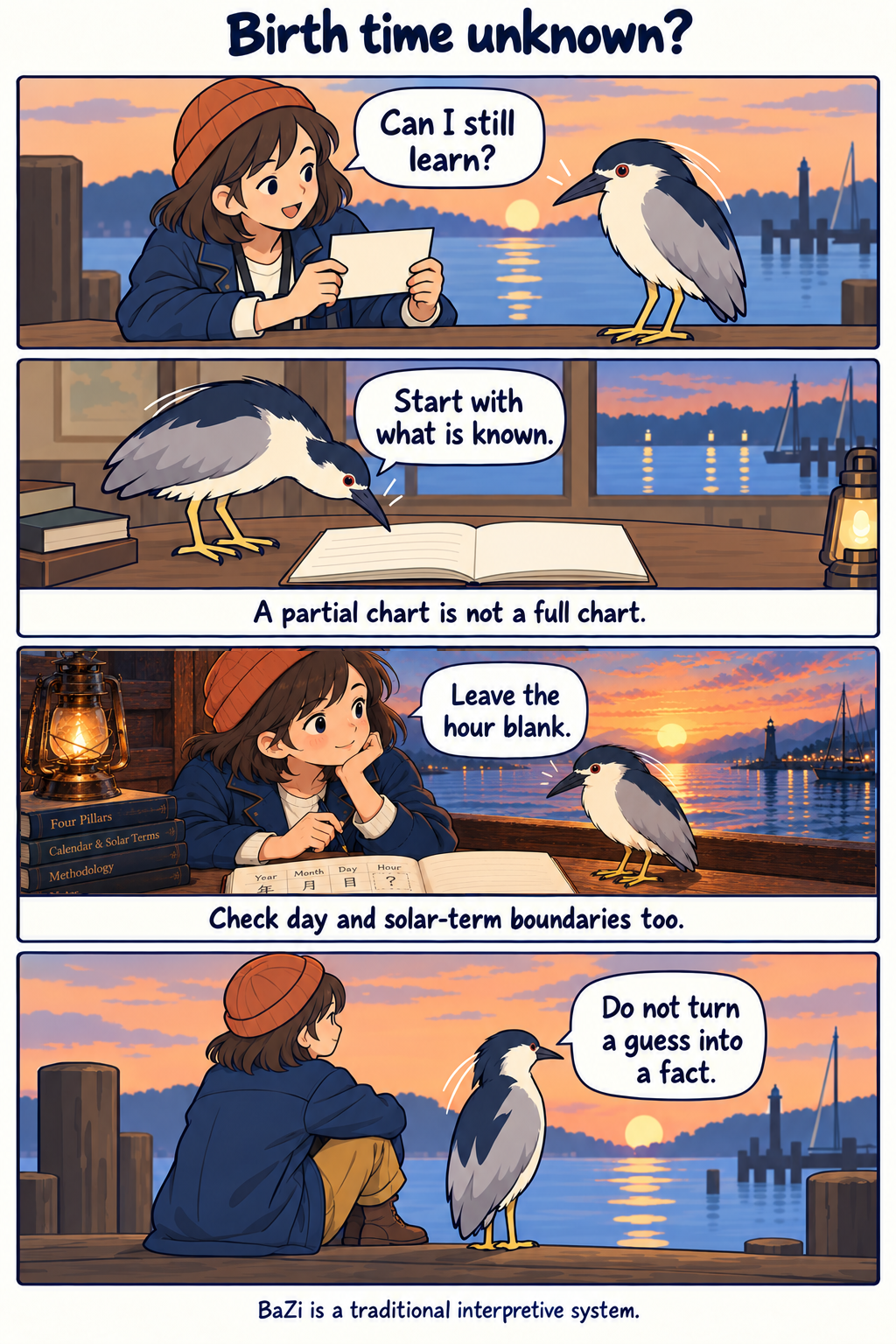
Study what is known. Leave the hour unresolved. Check whether the possible times cross day or solar-term boundaries.
Read the comic as text
- Apprentice: “Can I still learn?”
- Heron: “Start with what is known.” Caption: “A partial chart is not a full chart.”
- Apprentice: “Leave the hour blank.” Caption: “Check day and solar-term boundaries too.”
- Heron: “Do not turn a guess into a fact.”
BaZi is a traditional interpretive system.
The full guide

What does BaZi without birth time leave you with?
BaZi (八字, bā zì) is a traditional Chinese system that arranges birth information into four pairs of calendar characters. These pairs are the Four Pillars (四柱, sì zhù): year, month, day, and hour. Each pair belongs to a different part of the birth record.
A three-pillar chart contains the year, month, and day pairs. A complete four-pillar chart adds the hour pair. That difference matters because traditional interpretation considers relationships across the chart, rather than treating each pair as a separate answer.
Think of a sea chart with one area left uncharted. The marked coastlines still contain information, but they do not tell you what occupies the blank area. Drawing in a coastline because it looks plausible would make the map less honest.
This analogy has a limit: the missing hour can affect how the known characters are interpreted together. It is not simply a detachable fourth topic. Nor does having six of eight characters mean a reading is “75 percent accurate.” Counting characters cannot measure predictive accuracy.
What can you learn from the known pillars?
You can learn how the securely identified pairs are named and how they relate within the traditional framework. You can also begin understanding the seasonal setting associated with the month pillar. These are starting points for study, rather than a finished assessment of your life.
The day pair includes a character used as the chart’s reference point: the Day Master (日主, rì zhǔ). More precisely, this is the upper calendar character, or Heavenly Stem (天干, tiān gān), of the day pillar. If the day pillar is secure, that reference point can be identified without inventing an hour.
Knowing the reference point does not settle the interpretation. The missing pair may change the relationships being considered, so avoid firm claims about the chart’s overall balance. A personality description that feels familiar cannot establish the missing birth record.
Simplified example, not a calculated chart: Maya knows her birth date and birthplace. A family note places the birth between 10 a.m. and noon, but gives no exact time. She keeps that range instead of quietly replacing it with 11 a.m.
Maya can ask which year, month, and day pairs stay the same throughout that range under a stated calculation method. If those pairs are confirmed unchanged, she can study them as known information. Any hour-dependent reading remains conditional; this example assigns her no calendar characters or predicted events.
What should remain unresolved?
The hour pair itself remains unknown until the available evidence supports it. In traditional chart reading, a different hour pair can introduce different relationships with the existing characters. Conclusions that depend on those relationships therefore need to stay open.
For example, do not conclude that a particular element is absent from the complete chart after examining only three pillars. Something unseen is different from something confirmed absent. Even a complete chart does not support the simple rule that a missing element must be added.
Likewise, avoid turning a partial chart into definite statements about marriage, children, career, or later life. This article does not assign those subjects to separate pillars or promise that recovering the hour would make predictions certain. BaZi remains a traditional interpretive system, not a scientifically established way to predict events.
If personality symbolism is discussed, treat it as a tendency considered in the full chart, not a fixed prediction from one element. A useful conversation about a partial chart should explain its assumptions before offering conclusions. You should be able to tell which statements depend on the unknown hour.
Can the missing time change more than the hour?
Sometimes. A familiar date on a birth record does not automatically settle every calendar boundary used by a BaZi method. The main questions are whether the possible times cross a change of day or a solar-term transition.
A solar term is a seasonal marker based on the Sun’s position. BaZi year and month boundaries follow specific solar terms under the method used here. If a relevant transition falls within the possible birth-time range, the year or month pair may need more than one candidate.
The day boundary needs separate attention. marginalpoems uses a stated convention in which the BaZi day changes at 11 p.m. in the resolved local civil time. If the time is completely unknown, do not assume that the day pillar must be identical throughout the civil date.
Other methods may use a different day boundary or adjust the time differently. Birthplace and historical time-zone handling also matter when interpreting the recorded clock time. Our methodology describes how we document assumptions and uncertainty. Calculation choices are not evidence of a recovered birth time.
Maya’s morning range avoids an 11 p.m. day boundary, but it still needs checking against any relevant solar-term transition. If all she knew were the civil date, the uncertainty would be wider. Neither situation justifies silently treating one convenient time as the original record.
Should you enter noon or try to recover the hour?
Entering noon because a form requires a time supplies the calculator with an invented input. The software can return a neat, complete-looking chart from that input. Its appearance does not make the hour authentic, and an unlabelled placeholder can easily be mistaken for a fact later.
This guide does not offer an unknown-time mode for the marginalpoems Calculator. Do not use it to manufacture a complete chart when the birth time is missing. You can still learn from the written guides without submitting guessed birth details.
Start by checking records already available to you: a birth certificate, hospital record, family diary, or another document made near the birth. These may or may not include a time. Record where a time came from and whether it was documented, remembered, or estimated; “around breakfast” should remain an estimate.
Some practitioners compare possible hours with remembered life events, a practice often called birth-time rectification. Such a proposal is still an inference, not a recovered clock reading. Ask what independent evidence supports it, what alternatives remain, and what would count against the proposed hour.
For your own notes, separate three things: documented facts, reported ranges, and working guesses. If a range supports several possible charts, retain those alternatives rather than choosing the one with the most flattering description. New evidence can narrow the range later; an attractive interpretation cannot replace that evidence.
You can continue with how to read a BaZi chart to understand the reading sequence. For differences caused by settings, see why BaZi calculators give different results. Keep the blank area visible as you learn: a partial chart is a place to begin, with clear limits on what it can support.
FAQ
Can I find my Day Master without knowing my birth time?
Yes, if the day pillar is securely established under the chosen calculation convention. The Day Master is its Heavenly Stem. If possible birth times cross a day-change boundary, keep the alternative day pillars unresolved until better evidence is available.
Is a three-pillar BaZi chart accurate enough?
It can support limited study of securely identified information, but it is not a complete four-pillar chart. There is no reliable accuracy percentage obtained by counting the known characters. Any interpretation should say what depends on the missing hour.
What if I only know I was born in the morning?
Keep “morning” as a reported range, with its source. It may narrow the possibilities without selecting one hour pair. Check which pillars remain unchanged across the range, including any relevant seasonal boundary, rather than replacing the range with a single guessed time.
Can I use 12 noon as my birth time?
Noon is a placeholder unless evidence supports it. It can produce an hour pillar that looks certain but is based on a guess. This article does not claim that the marginalpoems Calculator supports unknown birth times.
Can a practitioner work out my exact birth time?
A practitioner may propose a time by comparing alternatives, but the proposal is not the same as a documented record. Keep its assumptions and uncertainty visible. A convincing description alone does not prove an exact birth time.
Keep the whole chart in view