Heavenly Stems
The 10 Day Masters in BaZi: Meanings & Personality
A tall tree builds a trunk; a climbing vine finds a way through the space around it. Both are Wood, yet they offer different pictures of growth. Jia Wood (甲, jiǎ) and Yi Wood (乙, yǐ) are two of the 10 Day Masters in BaZi (八字, bā zì): five elements, each expressed through a yin and a yang stem.
Your Day Master (日主, rì zhǔ) is the Heavenly Stem of your birth day’s pillar, the reference point for reading the chart. Its image offers more than a list of adjectives.
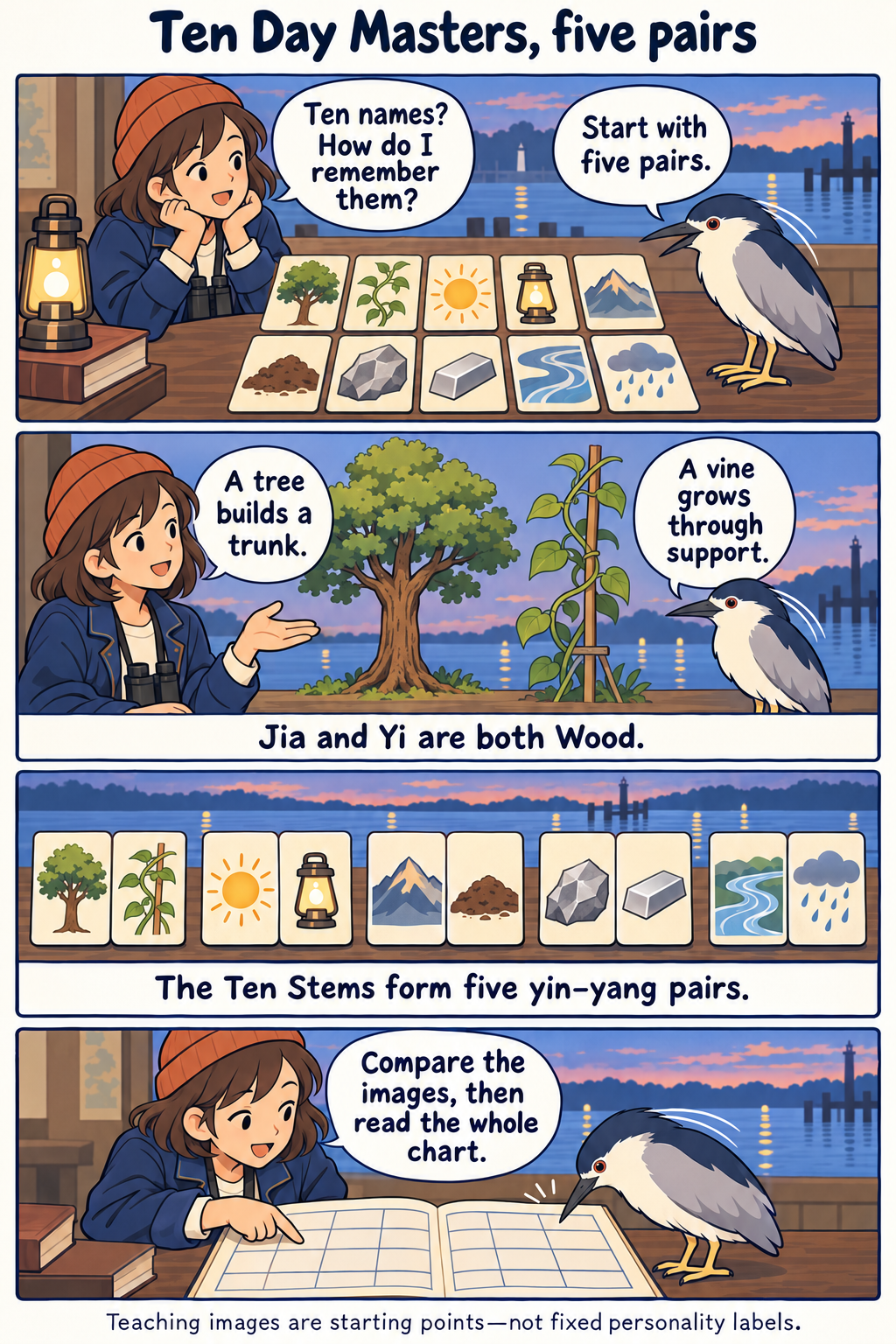
Read the comic as text
Apprentice: “Ten names? How do I remember them?”
Night heron: “Start with five pairs.”Caption: “Jia and Yi are both Wood.”
“A tree builds a trunk.”
“A vine grows through support.”“The Ten Stems form five yin–yang pairs.”
“Compare the images, then read the whole chart.”
Teaching images are starting points—not fixed personality labels.
Five yin–yang pairs
The full guide
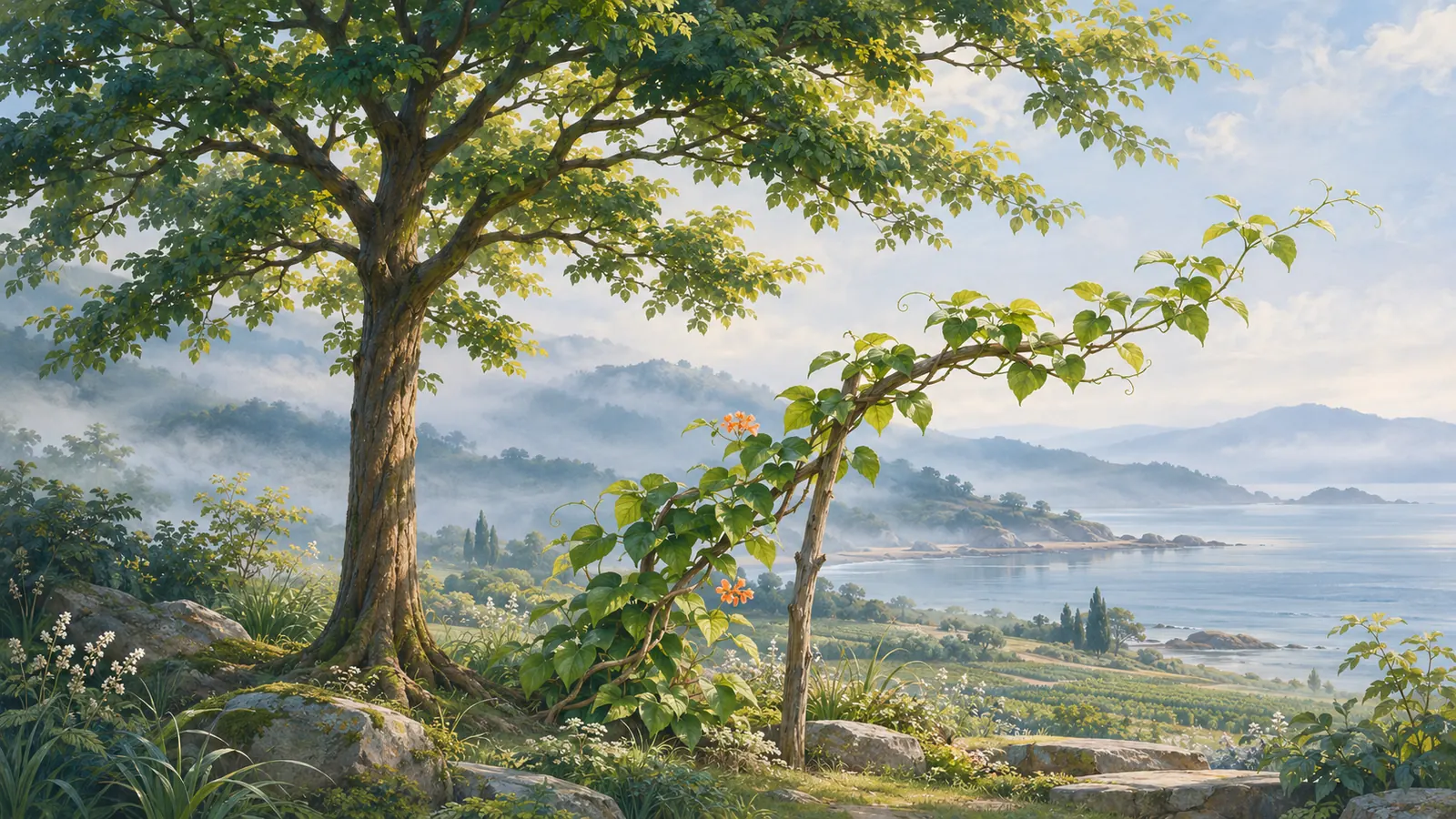
The 10 Day Masters at a glance
The ten Heavenly Stems (天干, tiān gān) form five pairs through yin and yang (阴阳, yīn yáng). Compare the two images within each element.
| Element | Yang Day Master | Yin Day Master | Contrast to notice |
|---|---|---|---|
| Wood | Jia (甲, jiǎ): tall tree | Yi (乙, yǐ): vine or flexible plant | Building a supporting structure / growing through available supports |
| Fire | Bing (丙, bǐng): sun | Ding (丁, dīng): lamp or flame | Broad illumination / a sustained, focused light |
| Earth | Wu (戊, wù): mountain | Ji (己, jǐ): cultivated soil | Holding the shape of the ground / providing a place for growth |
| Metal | Geng (庚, gēng): raw metal or blade | Xin (辛, xīn): refined metal or jewelry | Force and shaping / finish and distinction |
| Water | Ren (壬, rén): river or ocean | Gui (癸, guǐ): rain, mist, or dew | Gathering and carrying / reaching through fine distribution |
These are teaching images used to explain the stems. The personality associations below are modern reflective interpretations, not translations of classical verses or scientifically established personality types. Traditional readings consider tendencies within the whole chart.
Yin and yang do not mean introverted and extroverted, weak and strong, or female and male. A quiet person can have a Yang Day Master; a socially confident person can have a Yin one.
If you’re familiar with MBTI, think of how an “I” doesn’t necessarily mean someone is quiet or shy, and an “E” doesn’t mean they can’t enjoy time alone. Likewise, a Yin or Yang Day Master isn’t a rigid label for how someone behaves. This is an analogy about avoiding stereotypes—not a claim that BaZi’s yin and yang correspond to MBTI’s I and E.
If you have not identified yours, begin with how to find your BaZi Day Master.
Jia Wood and Yi Wood: two ways of growing
Calling Jia persistent and Yi flexible leaves out the more interesting distinction: what gives each kind of growth its form?
Jia Wood: a trunk that gives growth a direction
Symbolic image: A tall tree (甲木)
A tree develops a central structure. Its trunk holds the branches, carries growth upward, and eventually provides shade or support beyond itself. Jia’s image therefore suggests more than refusing to give up: it raises questions about building something lasting and taking responsibility for its shape.
In personality language, this can suggest commitment, clear principles, and reliability. The same attachment to structure can become rigid when a familiar way of growing no longer fits the surroundings.
Yi Wood: growth that works with its surroundings
Symbolic image: A climbing vine or flexible plant (乙木)
A vine reaches into available space, follows a support, and changes its course toward light. Its form emerges through contact with what surrounds it. Yi’s image brings attention to timing, connection, and finding room to develop.
That can suggest tact, resourcefulness, and an ability to keep possibilities open. The difficulty arises when responding to others leaves too little room for a direction of one’s own. Using support does not make the vine less alive or less capable of growth.
A simplified comparison, continued below: imagine arriving in an unfamiliar town. The Jia image asks, “What can I build a life around here?” The Yi image asks, “Where can I find connections and room to grow?” These are two ways of approaching the same beginning, not predictions about two actual people.
Bing Fire and Ding Fire: daylight and a light kept burning
Both images give warmth and light. Their difference concerns reach, focus, and how illumination is sustained.
Bing Fire: light that reaches a shared world
Symbolic image: The sun (丙火)
The sun illuminates a whole landscape. Under the Bing image, things become visible together: the open space, the people in it, and the possibilities ahead. In human terms, this can suggest openness, generosity, and enthusiasm that gives others something to gather around.
Its challenge is assuming that what feels clear or encouraging to one person will feel the same to everyone. Broad illumination does not automatically reveal every private need.
Ding Fire: light with a particular purpose
Symbolic image: A lamp or steady flame (丁火)
A lamp is placed somewhere and kept alight. It makes a page readable or lets a conversation continue after dark. Ding’s image draws attention to chosen focus, sustained care, and the conditions that let a small light keep doing its work.
This can suggest insight and devotion to something meaningful. It may also become overinvestment in one concern or in whether that care is recognized.
When a friend feels discouraged, the Bing image might be a shared meal that restores a sense of possibility. The Ding image might be staying afterward to listen to the one thing the friend has not yet said.
Wu Earth and Ji Earth: the ground that holds and the soil that grows
Earth offers support in both images, but support takes different forms. A mountain gives a landscape its shape; cultivated soil provides a place where something can take root.
Wu Earth: continuity, weight, and a firm outline
Symbolic image: A mountain (戊土)
A mountain remains a reference point while activity changes around it. Wu’s image emphasizes holding ground, containing space, and providing something dependable. It can suggest patience, steadiness, and boundaries that other people can rely on.
The challenge is immovability: preserving an arrangement because it has always stood, even when it no longer provides useful support.
Ji Earth: receiving, holding, and nurturing growth
Symbolic image: Cultivated soil (己土)
Cultivated soil holds moisture and nourishment around what is planted in it. Its usefulness lies in what it can receive and help develop. Ji’s image suggests practical care, resourcefulness, and attention to the conditions of everyday life.
Its challenge can be absorbing too many demands or treating everything nearby as one’s responsibility.
Imagine a relative moving into the family home for a while. Wu’s image draws attention to a dependable place and clear household boundaries. Ji’s image draws attention to meals, space, and routines that help the person settle. One emphasizes the framework; the other, what the framework makes possible.
Geng Metal and Xin Metal: shaping and refinement
A working blade and a finely finished piece of metal draw attention to different kinds of value.
Geng Metal: force brought to a useful edge
Symbolic image: Raw metal or a blade (庚金)
Raw metal can be worked into a tool; a blade can cut through resistance. Geng’s image concerns substance, shaping, and the force needed to make a decisive change. Its personality associations include resolve, directness, and willingness to face difficulty.
The challenge comes when every obstacle is treated as something to cut through, including situations that require patience or negotiation.
Xin Metal: value revealed through precise treatment
Symbolic image: Refined metal or jewelry (辛金)
Refined metal or jewelry makes quality visible through finish, proportion, and detail. Xin’s image asks what distinguishes a thing and what treatment allows that quality to show. It can suggest discernment, care with presentation, and sensitivity to standards.
Its challenge may be perfectionism or allowing a small flaw to overshadow the value of the whole.
While restoring an old piece of furniture, a Geng-like focus would be removing what is damaged and making it sound again. A Xin-like focus would be the join, finish, or detail that makes the restored piece feel complete.
Ren Water and Gui Water: a current and a fine rain
Water connects places in more than one way. A river carries things along a continuous course; rain reaches many small places through countless separate drops.
Ren Water: movement across a wider field
Symbolic image: A river or the ocean (壬水)
The river and ocean images emphasize volume, connection, and movement over distance. Ren suggests seeing beyond a single location and bringing different possibilities into contact. In personality terms, this can imply curiosity, breadth, and comfort with exploration.
Its challenge is dispersal: following so many possibilities that none receives enough sustained attention.
Gui Water: reaching what a broad current may pass
Symbolic image: Rain, mist, or dew (癸水)
Rain, mist, and dew suggest fine distribution and a less conspicuous presence. Gui’s image draws attention to small openings, gradual influence, and changes that are easy to overlook. Its personality associations include observation, imagination, and sensitivity to detail.
The challenge can be remaining with impressions and possibilities without bringing them into the open to be checked.
On a first visit to a new place, a Ren-like curiosity might follow routes between neighborhoods to understand the wider area. A Gui-like curiosity might linger over a small detail that changes the impression of one street. Scale and manner of contact distinguish the images; neither measures intelligence or depth.
From an image to a reading
Return to the unfamiliar town in the Wood comparison. Building a stable base and finding supportive connections are both part of making a life there. The tree and vine images help distinguish those needs without assigning either one to a single kind of person.
A tree still needs suitable ground, and a vine still has its own direction of growth. This is where the image opens into a traditional reading: what conditions surround this particular Day Master? Our beginner’s guide to reading a BaZi chart explains how the wider chart enters that question.
To find your starting point, open the BaZi Calculator, enter your birth details, and look for the Day Master in the result. Then return to its pair. Ask what the image helps you notice about your experience, including where the comparison stops fitting.
FAQ
What is the difference between yin and yang Day Masters?
Each element has two stems with distinct symbolic expressions. Jia and Yi both represent Wood, but a tree builds a central supporting structure while a vine grows through contact with its surroundings. Yin and yang distinguish these expressions; they do not classify people as introverted or extroverted.
Which Day Master is the best?
There is no universally best Day Master. A lamp can illuminate something that broad daylight misses; a river and rain reach the ground differently. Traditional interpretation asks how a stem functions in its particular chart, rather than ranking the ten symbols by talent or good fortune.
Why do I relate to several Day Masters?
These human parallels describe experiences many people share. Your chart also contains other stems and relationships. Recognizing yourself in several images can be useful for reflection, but it does not identify your Day Master. That comes from the Heavenly Stem of your birth day’s pillar.
What can my Day Master reveal about career and life direction?
Its image can introduce questions about how you approach responsibility, expression, or change: building a framework, cultivating something, making a decision, or refining a result. In a traditional reading, the Day Master also provides the reference point for interpreting the other chart characters. Those relationships help frame themes such as resources, expression, and authority. Career discussions need that wider pattern and timing context, alongside your actual skills and opportunities; a stem alone is not a job recommendation.
What can my Day Master reveal about relationships?
The images can prompt questions about how you offer support, express warmth, or respond to another person’s needs. For example, providing a steady base and attending to daily needs are different forms of care in the two Earth images. Traditional relationship interpretation goes further by considering the rest of the chart and its relationships to the Day Master, with methods differing among schools. Two Day Master names alone do not establish compatibility, a partner’s character, or when a relationship will begin. The overview offers questions to explore, rather than a verdict about a couple.