BaZi Basics
What Is BaZi? A Beginner's Guide to the Four Pillars
Your zodiac animal is only part of the picture. BaZi brings your birth year, month, day and hour into one traditional Chinese chart.
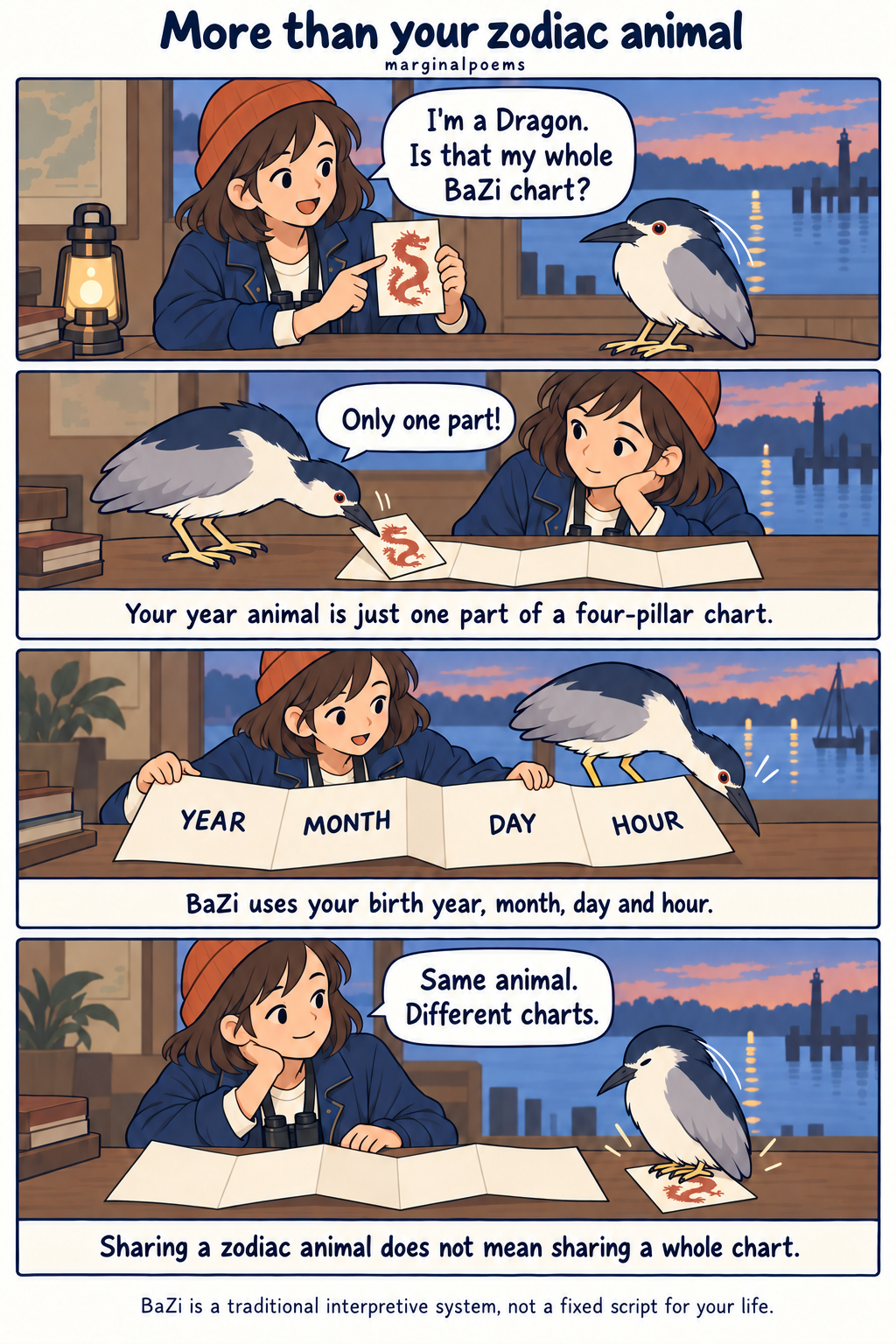
In BaZi, the year animal represents just one of eight characters. The full chart also includes your birth month, day and hour, so people with the same zodiac animal can have different charts.
A fuller chart is still a traditional interpretation—not a fixed future.
Read the comic as text
- “I’m a Dragon. Is that my whole BaZi chart?”
A navigation apprentice holds up a dragon card. Her night heron companion looks on.
- “Only one part!”
The heron nudges the card toward a folded paper. Your year animal is just one part of a four-pillar chart.
- Year · Month · Day · Hour
The apprentice unfolds the paper into four sections while the heron leans over to inspect it. BaZi uses your birth year, month, day and hour.
- “Same animal. Different charts.”
The heron settles onto the dragon card. Sharing a zodiac animal does not mean sharing a whole chart.
BaZi is a traditional interpretive system, not a fixed script for your life.
Beyond the year animal

BaZi (八字, bā zì) is a traditional Chinese system that turns your birth year, month, day, and hour into a chart called the Four Pillars. Practitioners use the chart to discuss temperament, relationships, life themes, and changing periods of time. It is not the same as your Chinese zodiac animal, and it does not produce a fixed script of future events.
What Does “BaZi” Mean in Plain English?
BaZi literally means “Eight Characters.” Your birth information is converted into four pairs of Chinese characters. Each pair forms one pillar:
- the Year Pillar
- the Month Pillar
- the Day Pillar
- the Hour Pillar
Think of the finished chart as a map. The four pillars provide the coordinates, and the rest of the system helps you read the terrain.
The map analogy matters because a map is useful without controlling your journey. It can show a steep slope, an open road, or a difficult crossing. It cannot force you to take one route, and it cannot account for every person, resource, or choice you meet along the way.
BaZi works in the same spirit. Traditional practitioners read patterns and timing conditions. They should not promise that one symbol guarantees a marriage, career, personality trait, or disaster.
How Is BaZi Different from the Chinese Zodiac?
The familiar zodiac animal comes from the Year Pillar’s lower character, called its Earthly Branch. That branch is represented by an animal such as Rat, Tiger, Horse, or Rooster. Near the start of the calendar year, popular zodiac systems and BaZi calculators may use different year boundaries, so they can occasionally assign different animals.
A full BaZi chart contains eight characters, not one. Two people born in the same zodiac year may have different month, day, and hour pillars. Their charts can therefore have different Day Masters, seasonal conditions, and relationships among the Five Elements.
On our map, the year animal is one landmark. BaZi reads the whole landscape.
This is why “I am a Dragon” and “My Day Master is Jia Wood” are not interchangeable statements. The first identifies a year branch. The second identifies the reference point used to interpret the entire chart.
What Are the Four Pillars Made Of?
Each pillar is a pair: a Heavenly Stem (天干, tiān gān) on top and an Earthly Branch (地支, dì zhī) below. These are two sets of calendar symbols used to build the chart.
Four pillars. Two characters in each.
Each pillar has a Heavenly Stem above an Earthly Branch. Four pairs make eight characters.
Year 年柱
Month 月柱
Day 日柱
Hour 时柱
There are ten Heavenly Stems. They express the Five Elements—Wood, Fire, Earth, Metal, and Water—in Yin and Yang forms. Jia is Yang Wood, for example, while Yi is Yin Wood.
There are twelve Earthly Branches. These are the characters commonly represented by the twelve zodiac animals. A branch also carries a seasonal role and contains one or more Hidden Stems (藏干, cáng gān). Those hidden contents are one reason a chart cannot be read by counting only the visible elements.
The Heavenly Stem of the Day Pillar is called the Day Master (日主, rì zhǔ). It is the chart’s “You Are Here” marker and the main reference point for classifying how the other seven characters relate to the person represented by the chart.
The four pillars also have traditional areas of emphasis. The Year Pillar may be read in relation to ancestry and early surroundings. The Month Pillar has a strong connection to season, family structure, and social or working conditions. The Day Pillar includes the self and partnership area. The Hour Pillar is often associated with children, later life, projects, and what develops over time.
These are reading frameworks, not four sealed boxes. Career, wealth, relationships, and other themes can appear through interactions anywhere in the chart.
How Do the Five Elements Work in BaZi?
The Five Elements (五行, wǔ xíng) are better understood as five processes than five physical substances:
- Wood describes growth and extension.
- Fire describes heat, visibility, and expression.
- Earth describes containment and transformation.
- Metal describes definition, structure, and cutting.
- Water describes movement, storage, and adaptation.
The elements generate and control one another in repeating cycles. Water nourishes Wood; Wood feeds Fire; Fire produces Earth; Earth bears Metal; Metal generates Water. A second cycle describes control: Wood parts Earth, Earth contains Water, Water cools Fire, Fire shapes Metal, and Metal cuts Wood.
These relationships create the chart’s basic grammar. An element can support the Day Master, draw energy from it, be controlled by it, or control it. Yin and Yang polarity then divides those relationships into the Ten Gods (十神, shí shén).
Despite the English name, the Ten Gods are not deities. They are ten relationship categories used to discuss themes such as support, expression, peers, resources, responsibility, and wealth.
How Does a Practitioner Read the Chart?
A careful reading follows a sequence rather than jumping from one character to a prediction.
First, identify the Day Master. Next, examine the Month Branch, because it establishes the season in which the chart was born. Then check whether the Day Master is reinforced by supportive elements, anchored in the branches (“rooted”), weakened by what it produces, or restrained by another element. Some characters may also join or conflict in ways that alter the pattern.
Classical Four Pillars practice gives the birth month priority because it establishes the chart’s seasonal climate. Start with that climate before judging a single element. Winter Water and summer Water do not enter the same environment.
Simplified teaching example: Maya has a Bing Fire Day Master and was born in winter. Fire does not receive the same seasonal support it would receive in summer.
That is only a first clue, not a full chart reading. Other stems, supportive characters hidden inside the branches, and relationships elsewhere in the chart may strengthen or redirect that Fire.
Only after examining the full structure does a practitioner consider the Useful God (用神, yòng shén). This is a technical term, not a deity. Depending on the school, it may refer to an element or function that helps regulate the season, supports the chart’s structure, or resolves a particular imbalance.
What Do Luck Pillars Add to the Map?
The birth chart is fixed, but the conditions around it are not. BaZi represents long-term change through Luck Pillars (大运, dà yùn), which usually cover ten-year periods. Annual pillars add a shorter one-year layer.
On the map, the terrain remains in place while the weather changes. A road that is easy in dry weather may become difficult during heavy rain. The road did not turn into a different road; the conditions changed how it could be used.
As Di Tian Sui (滴天髓) says:
理承气行岂有常,进兮退兮宜抑扬。
Lǐ chéng qì xíng qǐ yǒu cháng, jìn xī tuì xī yí yì yáng.
“Principle rides upon qi in motion — how could it ever stand still? In advance and in retreat, one must weigh restraint and release.”
The practical point is that the same natal pattern may be easier to express in one period and harder in another. BaZi uses these cycles to discuss timing, not to guarantee a specific event.
What Can BaZi Tell You—and What Are Its Limits?
You need a birth time to calculate the Hour Pillar. Without it, you still have the Year, Month, and Day Pillars, including the Day Master. That partial chart can support limited analysis, but it is not the complete Four Pillars chart.
There is no honest percentage such as “75% accurate.” The missing hour may matter greatly in one question and less in another. It can add important information about later life, children, projects, hidden stems, and Ten God relationships.
Time calculation also has conventions. Some practitioners use recorded civil time; others adjust for daylight saving time, longitude, or true solar time. If a birth falls near an hour or solar-term boundary, the chosen method should be stated clearly.
Within its traditional framework, BaZi can organize questions about temperament, recurring pressures, relationships, work, resources, and timing. Its value lies in showing how several conditions interact rather than reducing a person to one label.
It cannot prove that a future event must happen. It should not replace medical, legal, financial, or psychological advice. BaZi is a traditional interpretive system, not a scientifically validated prediction engine.
The best use of the map is not asking, “What is guaranteed?” It is asking, “What conditions does this framework draw my attention to, and what choices remain mine?”
FAQ
Q: Is BaZi the same as the Chinese zodiac?
A: No. The zodiac animal comes from the Year Branch, which is only one of the eight characters in a full BaZi chart. BaZi also uses the birth month, day, and hour, then studies how all four pillars interact. The year animal is therefore one landmark, not a summary of the whole chart.
Q: What information do I need for a BaZi chart?
A: You need your birth date, birth time, and birthplace. The birthplace helps a calculator handle the time zone and any time adjustments. If the birth time is unknown, you can still calculate three pillars, but the Hour Pillar will be missing.
Q: Is the Day Master my BaZi personality type?
A: The Day Master is the chart’s reference point, not a complete personality type. Its element and polarity provide one layer of symbolism, but season, roots, other characters, Ten God relationships, and Luck Pillars all change how it is interpreted. It cannot be understood responsibly without those surrounding conditions.
Q: Can BaZi predict an exact marriage date or career outcome?
A: BaZi practitioners may identify periods when relationship or career themes become more active. That does not guarantee marriage, promotion, loss, or any other event. Real outcomes also depend on personal choices, circumstances, and opportunities. The cycles describe changing conditions, not inevitable outcomes.
Q: Is BaZi a religion?
A: BaZi is generally practiced as a traditional system of calendrical calculation and interpretation, not as a religion. Its terminology developed in a culture where philosophy, cosmology, and daily practice overlapped, but reading a chart does not require worship or religious belief.
Read about our sources, translations and review process in our methodology.
Keep the whole chart in view