Five Elements
Five Elements in BaZi: What “Missing” Really Means
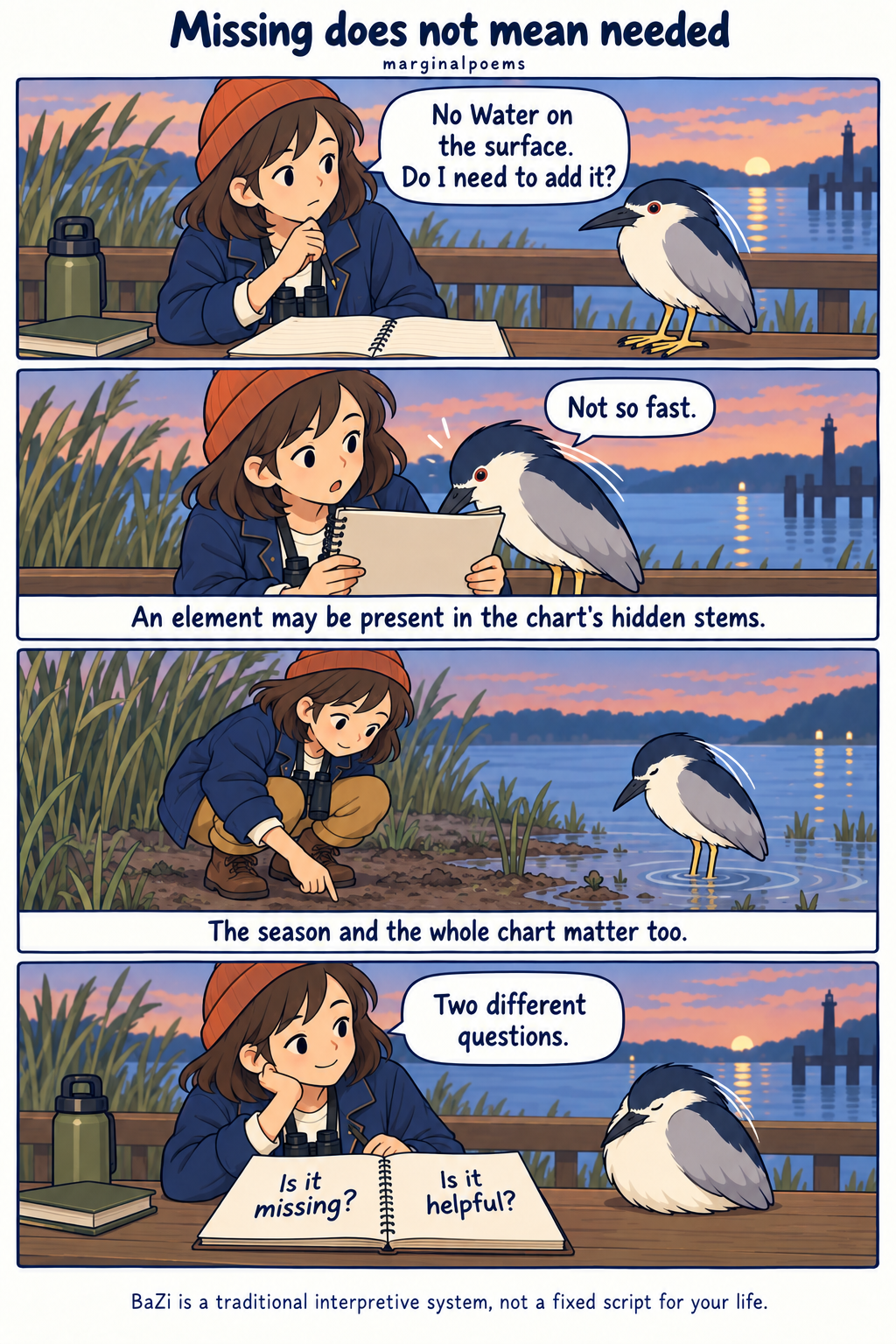
An element may be present in the chart's hidden stems. The season and the whole chart matter too.
An element may be present in the chart's hidden stems. The season and the whole chart matter too.
Is it missing? Is it helpful? Two different questions.
Read the comic as text
Apprentice: "No Water on the surface. Do I need to add it?"
Heron: "Not so fast." Caption: "An element may be present in the chart's hidden stems."
Caption: "The season and the whole chart matter too."
Notebook: "Is it missing?" and "Is it helpful?" Apprentice: "Two different questions."
BaZi is a traditional interpretive system, not a fixed script for your life.
The full guide

A missing element in a Five Elements BaZi chart is not automatically a weakness, and it does not tell you what to “add” to your life. Some charts show all five elements in the visible eight characters; many do not. Before judging an absence, you must ask where you looked, whether the element appears in hidden stems or seasonal influence, and whether the complete chart actually benefits from it.
What Are the Five Elements in BaZi?
The Five Elements (五行, wǔ xíng)—Wood, Fire, Earth, Metal, and Water—are five patterns used to describe how qualities change and relate. They are not simply five materials that a chart must collect in equal amounts.
- Wood grows and extends.
- Fire heats and makes visible.
- Earth contains and transforms.
- Metal defines and cuts.
- Water moves, stores, and adapts.
Think of a BaZi chart as an ecosystem. An ecosystem does not become healthy because it contains equal numbers of trees, flames, rocks, metal tools, and ponds. What matters is whether its processes can work together under the actual climate.
The elements generate one another in a cycle: Water nourishes Wood, Wood feeds Fire, Fire produces Earth, Earth bears Metal, and Metal generates Water. They also control one another: Wood parts Earth, Earth contains Water, Water cools Fire, Fire shapes Metal, and Metal cuts Wood.
A chart is read through these relationships, not through a five-item checklist.
For a foundation in the chart’s four-pillar structure, read What Is BaZi? A Beginner’s Guide.
What Does “Missing” Actually Mean?
The word “missing” can refer to several different checks, and online calculators do not always explain which one they use.
Each of the Four Pillars has a Heavenly Stem on top and an Earthly Branch below. Some branches also contain one or more Hidden Stems (藏干, cáng gān).
The narrowest check looks only at the four visible Heavenly Stems. A wider check adds each Earthly Branch’s main element. A more complete check opens each branch and examines all of its Hidden Stems, which may add one, two, or three stems to the picture.
Season matters as well. An element may be absent from the visible top row yet receive strong support from the Month Branch—the Earthly Branch in the month pillar, which carries strong seasonal weight. In our ecosystem analogy, rain may not be falling in the snapshot, but the ground may still hold plenty of water.
This creates two important rules:
- Not every BaZi chart is visibly missing an element. Eight visible positions can contain all five.
- An element that looks absent on the surface may still be present in hidden stems or seasonal influence.
The classical text Di Tian Sui (滴天髓) describes the five kinds of qi as partial or complete:
坤元合德机缄通,五气偏全定吉凶。
Kūn yuán hé dé jī jiān tōng, wǔ qì piān quán dìng jí xiōng.
“The receptive Earth joins its virtue with Heaven and the hidden mechanism flows through; whether the five qi are partial or complete determines fortune and misfortune.”
In plain English, unevenness matters—but it must be interpreted. The verse does not say that every chart needs equal quantities of all five elements.
Is a Missing Element the Same as a Needed Element?
No. This is the most important distinction in the entire topic.
“Missing” describes what does not appear under a chosen method of counting. “Needed” is an interpretive judgment about what helps the chart function under its season and structure.
Practitioners often discuss a Useful God (用神, yòng shén). Despite the English word “God,” this is not a deity. It means the element or function that a particular method considers most helpful to the chart’s structure. Different schools may emphasize strength, seasonal temperature, or a particular chart pattern when choosing it.
The Useful God may be absent, visible, hidden, or already present but weak. A missing element may be helpful, neutral, or harmful. There is no rule that turns “not visible” into “must add.”
The same caution applies to the Favorable God (喜神, xǐ shén), an element that supports the useful direction. Neither term can be selected from a five-element bar chart alone.
Can Two Charts Miss the Same Element but Need Different Things?
Yes. Consider two simplified fictional charts. Both show no Water among their visible eight characters.
Maya’s chart is very hot and dry, and a complete analysis finds that Water would help regulate its climate. In her case, the lack of visible Water may be meaningful.
Daniel was born in a cold season. Water has strong seasonal support and also appears inside the Hidden Stems, even though it is absent from the visible characters. A later Water influence might intensify conditions already present.
The surface label is the same: “no visible Water.” The interpretation is different because the ecosystems are different.
This example is deliberately simple. A real reading must also examine the Day Master, whether elements have support in the branches (their “roots”), and how the chart’s symbols combine, clash, or transform. It should not infer personality from one missing element.
Does a Missing Element Mean You Lack a Personality Trait?
No. Statements such as “no Water means no emotion” or “no Metal means no discipline” turn a relationship system into a personality quiz.
The elements can provide metaphors for behavior, but one element does not own one human quality. A person can learn discipline without visible Metal and express empathy without visible Water. Family, culture, education, experience, and choice remain real parts of a life.
Within BaZi, an element’s meaning also changes according to the Day Master and the Ten Gods—the system’s ten relationship categories. Water can fall into categories such as Resource, Output, or Wealth, depending on the Day Master. Its location and relationship matter as much as its presence.
Personality and destiny statements in BaZi are tendencies interpreted from the full chart, not fixed predictions drawn from a single missing element.
Can Luck Pillars Bring in a Missing Element?
Luck Pillars (大运, dà yùn) add a new stem and branch for a period of roughly ten years. Annual pillars add another shorter layer. These characters can introduce an element that is not visible in the natal chart.
That does not permanently repair a defective chart, because the natal chart was not a broken checklist to begin with. It means the relationships operating during that period have changed.
If a complete reading finds Water helpful, a Water Luck Pillar may make supportive Water themes more available. If Water is already excessive, the same pillar may increase strain. Combinations and clashes can also alter the result, so the element’s name alone is not enough.
The Luck Pillar is changing weather around the ecosystem. Rain can revive dry soil or flood saturated ground.
What Should You Do with a Missing Element?
Colors and crystals can be meaningful ways to express or reflect on Five Element symbolism. Some people choose them for their cultural associations, personal significance, or as a reminder of qualities they wish to cultivate. If a chart appears to lack an element, the more useful first step is to understand what that element means in the full chart.
Di Tian Sui warns against judging from one side alone:
道有体用,不可以一端论也,要在扶之抑之得其宜。
Dào yǒu tǐ yòng, bù kě yǐ yī duān lùn yě, yào zài fú zhī yì zhī dé qí yí.
“The Way has both substance and function; it cannot be judged from one side alone — the essence lies in supporting or restraining, each in its proper measure.”
The point is to read the relationships in the chart, not one missing label on its own. Colors or crystals can express a personal connection to an element, while the chart itself needs to be read as a whole.
A more honest response is to ask better questions: Is the element truly absent when hidden stems are included? Does the season already supply it? What relationship does it have with the Day Master? Which interpretive school is being used?
Use the result as a prompt for investigation, not a verdict.
- Check whether the tool means missing from visible stems, all eight visible characters, or the chart including Hidden Stems.
- Identify the Day Master and Month Branch.
- Examine seasonal support, roots, combinations, and the full structure.
- Separate “missing” from “useful” or “favorable.”
- Reject fixed personality, health, or destiny claims based on the absence alone.
The useful question is not “How do I replace what I lack?” It is “Does this apparent absence matter in the complete chart?”
FAQ
Q: Is every BaZi chart missing at least one element?
A: No. Eight visible character positions can include all five elements. Many charts do omit one or more on the surface, but the answer changes when you include the Hidden Stems inside the branches and the seasonal influence of the Month Branch. Before accepting a calculator’s result, check whether “missing” refers only to visible stems, all eight visible characters, or the fuller chart.
Q: If Water is missing, does that mean I am unemotional?
A: No. Water can take on different meanings through the Ten Gods, depending on its relationship to the Day Master. Its absence cannot diagnose emotional capacity, empathy, or relationship style. Those qualities also develop through family, culture, education, experience, and personal choice. Treating “no Water” as “no emotion” oversimplifies both the chart and the person.
Q: Is the missing element automatically my Useful God?
A: No. The Useful God is selected by interpreting the chart’s season, strength, structure, and the method a practitioner follows. It may be missing, visible, hidden, or already present but weak. A missing element can also be neutral or unhelpful. A five-element bar chart alone does not provide enough context to identify the Useful God.
Q: Can a Luck Pillar supply an element missing from my natal chart?
A: Yes, a Luck Pillar can introduce that element for a period of roughly ten years and change how the chart’s relationships operate. Whether the change is supportive depends on the complete natal structure, the pillar’s stem and branch, and their combinations or clashes with the original chart. The arrival of a missing element is not automatically good and does not permanently “repair” the chart.
Q: Should I wear a color associated with my missing element?
A: You can choose a color or crystal for its personal or symbolic meaning. If you want to connect that choice to your BaZi chart, first consider whether the element is truly absent and how it relates to the chart as a whole. A missing label alone does not tell you which element to choose.
Read about our sources, translations and review process in our methodology.
Keep the whole chart in view