Chart Reading
How to Calculate a BaZi Chart: A Beginner's Guide
First, check the original inputs. Then compare time zones, clock adjustments and calendar boundaries.
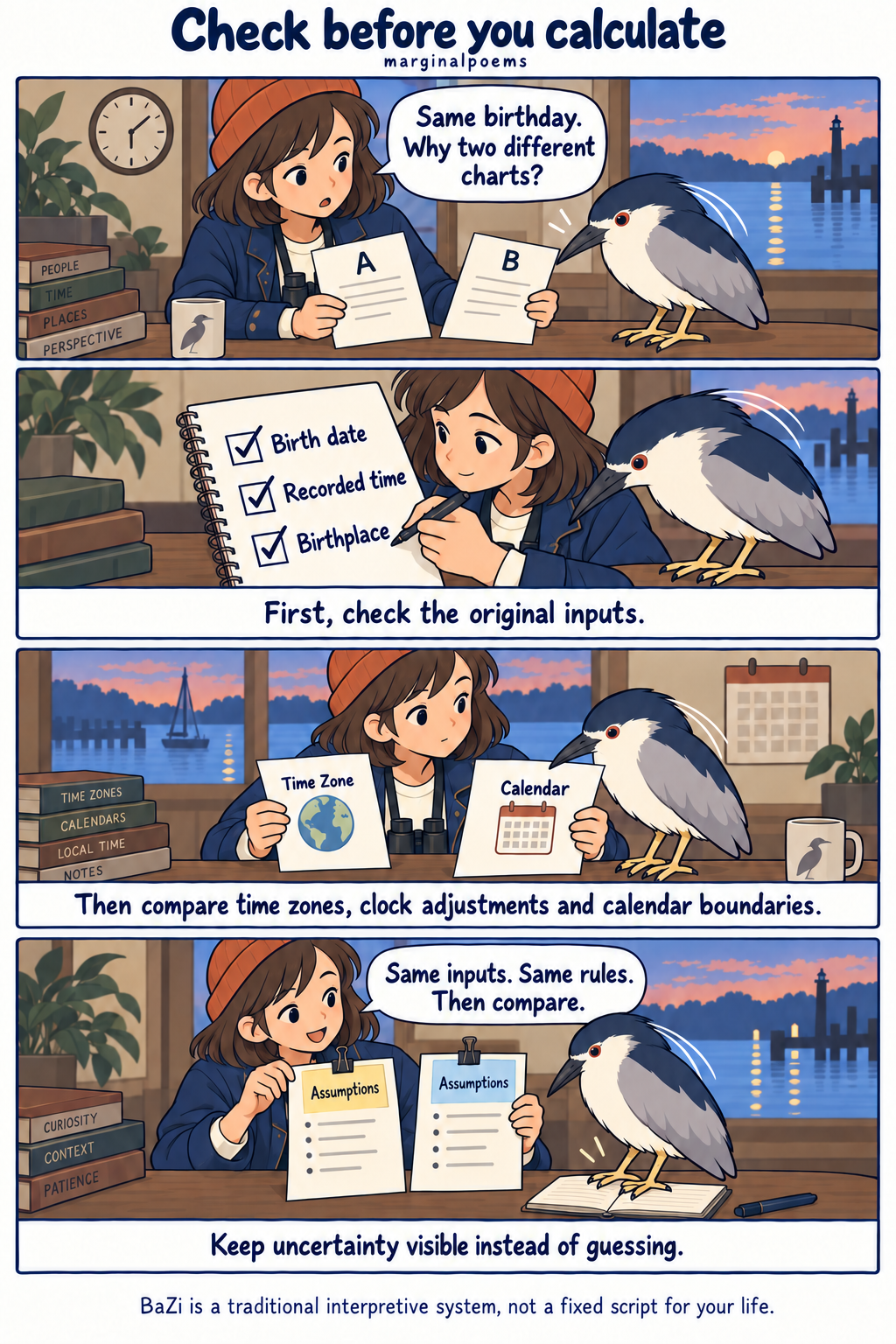
First, check the original inputs. Then compare time zones, clock adjustments and calendar boundaries.
Same inputs. Same rules. Then compare. Keep uncertainty visible instead of guessing.
Read the comic as text
Apprentice: "Same birthday. Why two different charts?"
Notebook: "Birth date" / "Recorded time" / "Birthplace" Caption: "First, check the original inputs."
Caption: "Then compare time zones, clock adjustments and calendar boundaries."
Apprentice: "Same inputs. Same rules. Then compare." Caption: "Keep uncertainty visible instead of guessing."
BaZi is a traditional interpretive system, not a fixed script for your life.
The full guide

A BaZi chart assigns a stem-and-branch pair to the birth year, month, day, and hour, producing eight characters. In a common Zi Ping method, year and month use solar-term boundaries, while day and hour follow the continuous 60-pair cycle and a stated time convention. The result is reproducible once the birth data and conventions are fixed. This guide explains that process and its error points; it is not a complete hand-calculation manual.
If you’re new to the system, start with our beginner’s guide to What Is BaZi? before diving into the math.
What Are You Calculating in a BaZi Chart?
Think of the chart as a four-row time table. The rows are year, month, day, and hour. Each row receives a Heavenly Stem (天干, tiān gān) and an Earthly Branch (地支, dì zhī). Together, the four pairs are called the Four Pillars (四柱, sì zhù).
The ten Heavenly Stems and twelve Earthly Branches combine into a 60-pair cycle called the sexagenary cycle. Each pillar pulls one pair from that cycle. The result is eight characters total — hence the Chinese name for BaZi, which literally means “eight characters.”
The Day Pillar’s stem is called the Day Master (日主, rì zhǔ). It is the chart’s reference point for the person being read. Finding it is part of calculation; deciding what its relationships mean is interpretation. Keeping those stages separate makes disagreements easier to trace.
Why Might Your Lunar Zodiac Year Not Match the BaZi Year?
This guide follows a common Zi Ping convention in which the year changes at Start of Spring and the months change at major solar-term boundaries. These boundaries mark seasonal points in the sun’s apparent annual path. A result based only on lunar-month boundaries will not match this method.
Start of Spring (立春, lì chūn) usually falls on February 3 or 4. February 1, 1990, came after that year’s lunar new year but before Start of Spring. A lunar-zodiac source may therefore call the year Horse, while this Zi Ping convention still assigns the previous Snake year pillar.
Neither label explains the other because they use different boundaries. Before comparing two results, first check which calendar convention each source states.
How Do You Find the Year and Month Pillars?
To find the Year Pillar under this method, first determine whether the birth moment falls before or after that year’s Start of Spring. Then look up the applicable year in a checked sexagenary table. After Start of Spring in 1990, for example, the Year Pillar is Geng Wu (庚午, gēng wǔ); before the boundary, the preceding pillar applies.
The Month Pillar does not follow the first day of a Gregorian or lunar month. Each BaZi month begins at one of twelve major solar-term boundaries, often called jie (节, jié). The month branch carries the chart’s seasonal reference, sometimes called the Month Command (月令, yuè lìng). The Tiger month, for example, begins at Start of Spring.
The month’s branch is fixed by the solar-term period. The month’s stem depends on the year’s stem and is derived with the Five Tigers method (五虎遁, wǔ hǔ dùn). You do not need to memorize it; a standard reference table shows the sequence.
Classical Zi Ping practice gives the month special weight because it represents the season of birth. A note on the phrase “Useful God” (用神, yòng shén): it sounds spiritual in English, but it is a technical term rather than a deity. Different schools use it for the operative element or function that addresses the chart’s season, structure, or imbalance.
Simplified workflow example: suppose a checked calendar has already placed Mei after the Geng-year boundary and inside the Shen month (申月, shēn yuè). The Five Tigers table starts a Geng year with Wu Yin and advances one pair per month. At Shen month, it gives Jia Shen (甲申, jiǎ shēn) as the Month Pillar.
This example demonstrates the lookup sequence, not a real person’s chart. A reproducible calculation would also record Mei’s full date, clock time, birthplace, time zone, daylight-saving status, and the boundary convention used by the source.
How Do You Find the Day and Hour Pillars?
The Day Pillar follows the 60-pair cycle continuously. A hand calculation counts from a verified reference date; in practice, most beginners should use a checked calendar or calculator. A one-day input error changes both the Day Pillar and the Hour Stem derived from it.
The hour pillar depends on the day stem. Under the standard two-hour system, the Shen hour (申时, shēn shí) runs from 3:00 to 5:00 PM. To find its stem, you use the Five Rats method (五鼠遁, wǔ shǔ dùn)—not the Five Tigers method used for months. The table derives the hour stem from the day stem.
Continue the simplified example. Suppose the stated calendar assigns Mei a Geng Chen day (庚辰, gēng chén), and her time under the chosen convention falls in the Shen two-hour period. For a Geng day, the Five Rats table gives Jia at Shen, so the Hour Pillar is Jia Shen.
So Mei’s complete chart is:
- Year: Geng Wu
- Month: Jia Shen
- Day: Geng Chen
- Hour: Jia Shen
Her Day Master is Geng Metal. These four pairs are illustrative outputs from stated lookups, not a substitute for entering and checking complete birth data.
What Happens After the Eight Characters Are Calculated?
Once you have the eight characters, the real work begins. The first step is assessing the Day Master’s strength. Is Geng Metal strong or weak in Mei’s chart? That depends on the season, the other stems, and what’s hidden inside the branches.
Each Earthly Branch also contains one or more Hidden Stems (藏干, cáng gān), additional stems used during interpretation. The Shen branch, for example, contains Geng Metal, Ren Water, and Wu Earth. They do not change the eight-character calculation, but they matter when a practitioner evaluates the chart’s relationships.
Di Tian Sui puts it this way:
能知衰旺之真机,其于三命之奥,思过半矣。
Néng zhī shuāi wàng zhī zhēn jī, qí yú sān mìng zhī ào, sī guò bàn yǐ.
“Grasp the true mechanism of strength and weakness, and you have already understood more than half of the mysteries of destiny.”
In plain English, the quotation says that evaluating strength and weakness is a major interpretive task. It does not mean that one score or automated element count can settle the chart.
For Mei, Geng Metal is born in autumn (Shen month), which is the metal season. Traditional BaZi holds that metal is at its peak in autumn, so her Day Master is naturally strong. But that’s just one factor — the full analysis would weigh the other branches, the hidden stems, and the interactions between pillars.
With the same birth data, boundary rules, and time convention, the calculation should be reproducible. Results can differ when tools silently use different day boundaries, solar-time adjustments, or solar-term rules. Interpretation adds another layer of disagreement because schools may weigh season, structure, the Five Elements, and the Ten Gods differently.
Traditional BaZi describes traits and life themes as tendencies interpreted from the full chart, not fixed predictions from a single element. Calculation alone makes no personality claim. For a careful next step, use How to Read a BaZi Chart and keep the chosen method visible.
What Mistakes Do Beginners Make When Calculating Their Own Chart?
A common error is using lunar new year where the chosen Zi Ping method uses Start of Spring. That changes the Year Pillar and can change the Month Stem, though the Day Pillar still follows its own continuous cycle.
The second error is using a time convention without knowing it. Some practitioners use recorded civil time, while others correct for daylight saving time, longitude, or true solar time. Near an hour boundary, those choices can change the hour pillar. Record the birthplace and the clock time, then use a calculator that states its convention.
The third error is misplacing an hour boundary. In the standard system, each branch covers about two hours and Shen begins at 3:00 PM under the chosen time convention. Births close to a boundary require careful adjustment. Some schools also differ on when the BaZi day changes during the Rat hour, so the method should be documented rather than hidden.
For most beginners, the safest approach is to use a calculator that states its solar-term, day-boundary, and time-adjustment rules. Save the original input and the stated convention, then cross-check the result against a second source using the same method. Agreement under different hidden assumptions is not a reliable check.
FAQ
Q: Why is my BaZi year different from my Chinese zodiac year? A: In the common Zi Ping convention used in this guide, the year changes at Start of Spring, usually around February 3 or 4, rather than at lunar new year. If you were born near that period, a lunar-zodiac source and a BaZi calculator may assign different year animals. Check the exact boundary time and confirm which convention the calculator uses.
Q: Do I need my exact birth time to calculate my chart? A: You need the birth time to calculate the Hour Pillar. Without it, you can still calculate the Year, Month, and Day Pillars, including the Day Master, but the result is a three-pillar chart rather than the complete Four Pillars. Near a day boundary, even identifying the Day Pillar may require the recorded time and the method’s day-change rule.
Q: What if I was born on the boundary between two hours or two solar terms? A: Record the most precise birth time and birthplace available. Then use a source that states the solar-term transition, time zone, daylight-saving treatment, and whether it adjusts civil time by longitude or true solar time. If the recorded time is uncertain or lies near a boundary, preserve both possible results and state the uncertainty instead of choosing silently.
Q: Can I calculate my chart without memorizing any formulas? A: Yes. A calculator or checked reference calendar can supply the four pillars without memorizing the Five Tigers, Five Rats, or day-count formulas. You still need accurate inputs and visible assumptions: birth date, recorded time, birthplace, time zone, daylight-saving status, solar-term boundary, and day-change convention. Keep those details with the result so another source can reproduce it.
Q: Is BaZi calculation the same as fortune-telling? A: Calculation assigns calendar symbols; interpretation is the stage that connects those symbols with life themes. The same birth data produces the same eight characters only when the boundary and time conventions also match. BaZi interpretation is a traditional practice, not a scientifically validated prediction method, and it should not replace medical, legal, financial, or psychological advice.
Read about our sources, translations and review process in our methodology.
Keep the whole chart in view